The main types of hay bales are small square bales weighing 40 to 80 pounds, round bales weighing 800 to 1,700 pounds, and large or medium square bales weighing 800 to 1,200 pounds (University of Minnesota Extension). Which one fits your operation depends on how you feed, store, and handle hay through the winter, what equipment you have to move bales, and how much labor you can spend on feeding day.
If you are a cow-calf producer deciding between bale types for your herd, this article walks you through the weight ranges, the practical trade-offs between handling and waste, how to figure actual bale weights instead of guessing, and how much hay to plan for before the season starts.
This guide draws on university extension research and USDA data on hay storage, bale density, and winter feeding, translated into steps you can use on your own operation.
What are the different types of hay bales?
A cow-calf operation chooses between three bale types: small square bales, round bales, and large square bales, each with different handling needs and weight ranges.
A small square bale is a hay bale measuring roughly 14 to 18 inches on each side and 36 to 40 inches long, weighing 40 to 80 pounds and handled by hand or with a small bale grabber. The USDA reports standard square bale weights at 40 to 50 pounds. Small squares are the lightest option and need no machinery to move, but handling them in volume is labor-intensive.
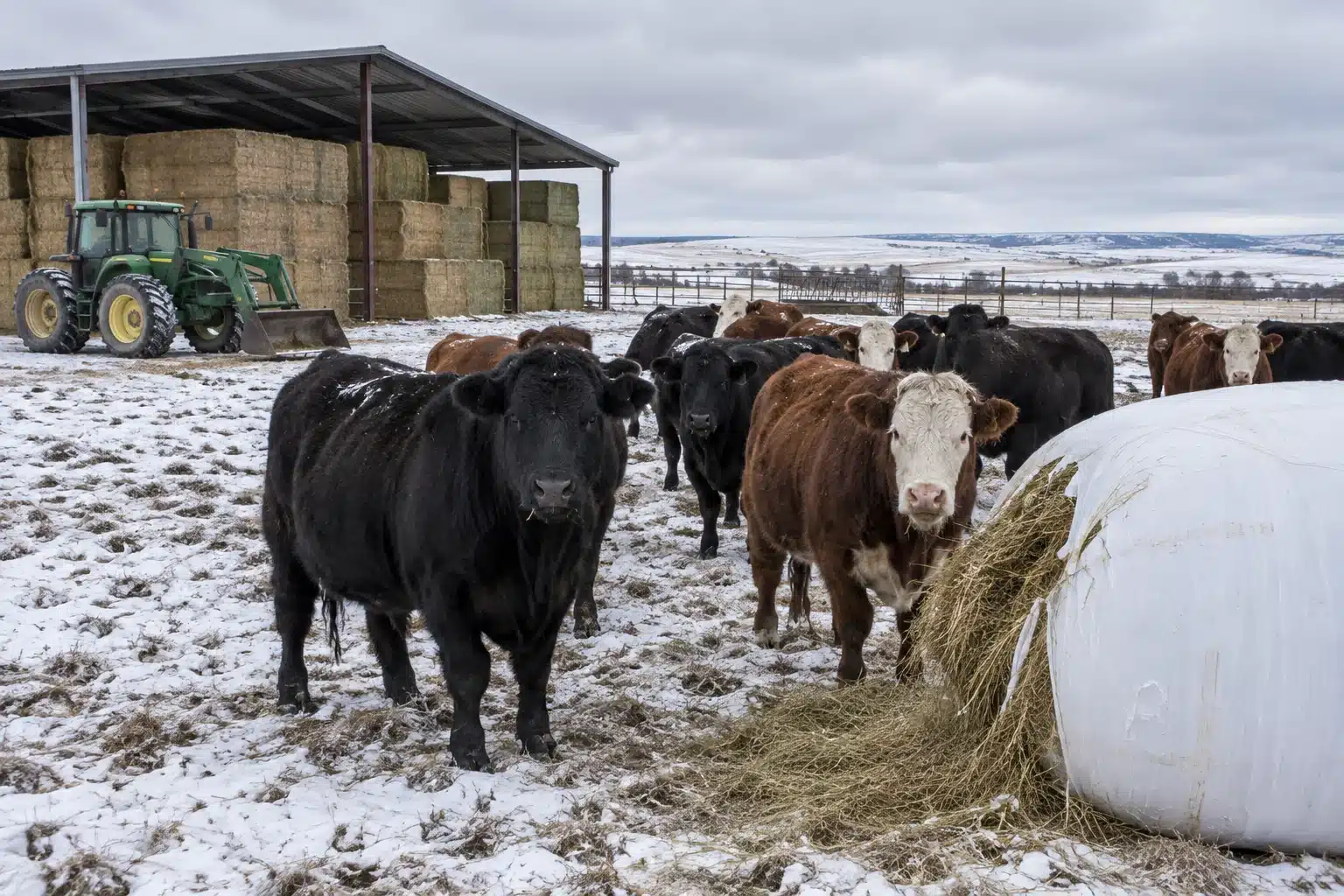
A round bale is a cylindrical hay bale typically 4 to 5 feet in diameter and 4 to 5 feet wide, weighing 800 to 1,700 pounds and moved only by tractor or skid steer (Penn State Extension). Round bales hold more feed per unit than small squares but require equipment and more storage space. Most agricultural operations wrap round bales individually or wrap them into a row to preserve feed quality. A wrapped bale is a round bale covered with plastic film, net wrap or twine during baling to hold the bale together and protect it from weather during storage.
A large square bale is a hay bale measuring 3 to 4 feet on each side and 8 feet long, weighing 800 to 1,200 pounds and requiring a tractor to move but flaking off more easily for individual feeding than a round bale. Large squares occupy less storage space than rounds of the same weight and stack more efficiently, though they still demand powered equipment to handle.
Round bales vs square bales: which is the better choice for feeding cattle?
Small square bales waste less hay than round bales when fed and stored properly, but they are very labor-intensive compared to large bales. The choice depends on whether you have the time and equipment to move small squares, or whether the labor savings of large bales outweigh the extra hay that gets wasted or weathered away.
Round bales fed without a feeder lose hay to trampling and scatter, but feeding more than one animal off the same bale cuts that waste significantly. Baling moisture the water content of hay at the time it is baled also affects what you can safely buy. Small square bales tolerate up to 17 percent moisture with limited risk of mold formation, while round bales must be baled at 15 percent moisture or less to prevent mold. If you are buying round bales, check the baling conditions that season; hay baled in wet weather costs you feed quality even if the bale looks sound.
If you bale your own hay, round balers have a high center of gravity and can tip sideways if a wheel drops into a ditch or hole, so watch for uneven ground when operating one.
How much does a round bale of hay weigh?
Not every round bale weighs 1,000 pounds, and most weigh less, because weight depends on bale size and how tightly the hay was compressed when it was made (University of Missouri Extension). The tightness of packing is called bale density—the weight of dry matter packed into each cubic foot of the bale—and it ranges from loose to very firm (University of Missouri Extension).
To estimate what a bale will weigh before it arrives, you can press or spike the bale by hand or note how it responds under a tractor’s weight. Loose, spongy bales have a density of 9 pounds of dry matter per cubic foot or less. Bales that deform slightly when pressed or spiked will likely have 10 pounds of dry matter per cubic foot or less. Rigid bales that deform only when pressed hard will likely have 11 pounds of dry matter per cubic foot. Bales that only deform under the tractor’s weight will likely have 12 pounds of dry matter per cubic foot or more.
Here is what common round bale sizes actually weigh at different densities:
| Bale Size (Width × Diameter) | Density (lbs DM/cu ft) | Weight (lbs dry matter) | Notes |
|---|---|---|---|
| 4 ft × 4 ft | 9 (loose) | 450[5] | Very light; soft to the spike |
| 4 ft × 5 ft | 12 (firm) | 940[5] | Typical high-density range |
| 4 ft × 5 ft (typical range) | Variable | 750–950[6] | More than 20% difference possible |
| 5 ft × 5 ft | 9 (loose) | 880[5] | About 98 cubic feet[5]; soft bale |
| 5 ft × 5 ft | 12 (firm) | 1,180[5] | Well-packed; deforms only under load |
| 5 ft × 5 ft (normal density) | 10–11 | ~1,000[7] | The common planning figure |
The difference matters: a 5 ft × 5 ft bale can range from 880 to 1,180 pounds of dry matter depending on how tightly it was packed—a difference of 300 pounds. When you are sizing a winter hay order or calculating how many bales to move, test the bales you are buying by hand-pressing a sample from the stack, or ask the seller to state bale weight and density. The common planning figure of 1,000 pounds fits a 5×5 bale packed at about 10 to 11 pounds of dry matter per cubic foot. Looser bales weigh less, and firmer bales at 12 pounds per cubic foot can reach about 1,180 pounds.
How many bales of hay do you need per cow for the winter?
To size a winter hay order, work from the daily feed need per head, the weight of the bales you are buying, and the number of days you will be feeding hay. Producers usually plan for roughly 33 pounds of hay per cow per day (University of Missouri Extension). A 5-foot by 5-foot round bale of normal density should weigh roughly 1,000 pounds, which will provide a day’s worth of feed for 30 cows.
Here is a worked example showing how to calculate total bales needed and feed cost for a 30-head cow herd over a 150-day winter feeding period.
| Example | Amount |
|---|---|
| Animals | 30 |
| Feed per head per day | 33 lb |
| Feed per day for the group | 990 lb |
| Days | 150 |
| Feed for the period | 148,500 lb (74.25 tons) |
| Feed price | $120 per ton |
| Feed cost for the period | $8,910.00 |
| Cost per head per day | $1.98 |
Example only, with made-up round numbers. Leaves out waste, minerals and hauling. Use your own feed analysis and the price you pay.
This example shows that a 30-head herd eating 33 pounds per head per day will need 148,500 pounds of hay over 150 days of winter feeding—or about 74.25 tons if bought by weight. At normal-density 5×5 round bales weighing about 1,000 pounds each, that is roughly 149 bales for the period.
The catch is that this calculation assumes your bales weigh 1,000 pounds, which matches a 5×5 bale packed at about 10 to 11 pounds of dry matter per cubic foot. Many round bales weigh less than that. If the bales you buy are loosely packed at 9 pounds of dry matter per cubic foot, a 5×5 bale will weigh only about 880 pounds—meaning you will need about 169 bales instead of 149 to feed the same herd for the same number of days.
How does storage cut into the hay you paid for?
Hay stored outside without cover can lose nearly half its feed value to weather, so every bale left bare costs you money you already spent. Round bales stored outside without cover lose dry matter to weather, concentrated in the outer 2 to 8 inches of the bale (Oklahoma State University Extension).
Two inches of weathering on a 5-foot bale costs you 13 percent of the dry matter; 8 inches costs 46 percent. A covered bale whether wrapped with plastic, canvas, or net at baling time holds up far better than one left bare to the weather.
A single uncovered 5-foot bale needs up to 63 square feet of cover if stored alone, but stacking three high outdoors brings that down to as little as 13 square feet per bale. A 36-by-64-foot building stacked three high holds roughly 231 bales at 1,000 pounds each—that is about 21 square feet of storage per ton. Interior clearance should be at least 2 feet higher than your finished stack height.
If you must store bales outside, a few habits cut losses sharply:
- Set bales on a well-drained surface such as gravel, pallets, or old tires, never on bare soil, where the bottom soaks up moisture.
- Line rows north to south so both sides get sun and dry after rain.
- Butt bale ends tightly together in a row and leave at least 3 feet between rows so air can move.
- Keep bales out from under trees and away from fence lines, where snow drifts and water collects.
- Don’t stack uncovered round bales in a pyramid outside; the top bales funnel rain into the ones below.
B-Wrap costs about $8.33 per large round bale; net wrap runs $1.17 per bale and twine $1.00. If an 880-pound bale loses 46 percent of its dry matter to 8 inches of weathering, you lose roughly 400 pounds of feed value. Wrap at any cost is cheaper than feeding that much waste to the weather. Store what you can inside; wrap what stays outside.
Does the type of hay inside the bale matter as much as the bale size?
Yes, but bale size and hay type are separate decisions that both affect what your cattle get. Grass hay, legume hay such as alfalfa, and three-way hay—a hay blend containing grass, legume and other plant species mixed together in one bale to balance protein and energy differ in protein content and digestible energy, and which one belongs in your bales depends on whether the hay is going to dry cows, pregnant pairs, or growing calves.
Before you commit to a large hay purchase, pull a forage test on samples from the lot. A forage test is a laboratory analysis of hay samples that measures protein, energy, fiber, minerals and other nutrients to confirm the feed value matches the price. For grass and legume species that perform well in your region and season, contact your local extension office; they know which species and varieties suit your climate and soil, and can point you to seed or hay growers in your area.
For an accurate forage test, use a hay probe instead of grabbing a handful from the outside of a bale. Take one core from the curved side of 15 to 20 bales in the same lot, mix the cores in a clean bucket, and send one combined sample to the lab. Test each lot separately, because hay cut from different fields or on different dates can differ a lot in quality.
| Hay Type | What’s in the Bale | Crude Protein (typical) | Energy (TDN, typical) | Fiber Level | Key Nutrition Notes | Best Suited For |
|---|---|---|---|---|---|---|
| Grass hay (e.g., timothy, bermuda, brome, orchardgrass) | Grass species only | 7–12% | 50–58% | High | Lower protein and energy; filling and safe to feed in larger amounts; usually the most affordable | Dry cows and mature cows in early to mid pregnancy, when needs are lowest |
| Legume hay (e.g., alfalfa, clover) | Legume species only | 15–22% | 55–62% | Lower | Highest protein; rich in calcium; very palatable; overfeeding can waste protein or add cost | Growing calves, lactating cows, and as a protein supplement for lower-quality hay |
| Three-way (mixed) hay | Grass, legume, and other plant species blended in one bale | 11–16% | 54–60% | Moderate | Balances protein and energy in one feed; quality depends on the legume share in the mix | Pregnant cows late in gestation and cow-calf pairs that need more than grass alone |
Weigh your hay before winter feeding starts
Weigh several bales from each lot and compare the average to the seller’s claim. Most round bales weigh less than the 1,000 pounds often quoted, and density can vary widely even among bales of the same size. A truck scale at a grain elevator, a livestock scale, or a scale on your loader can do the job.If you don’t have access to a bale scale, weigh the whole load instead. Run the loaded truck and trailer across a grain elevator or co-op scale, unload, weigh again empty, and divide the difference by the number of bales. Doing this for one load from each lot gives you a reliable average weight with very little effort. Weigh at least 3 to 5 bales per lot and use the average, because one bale can mislead you.
Once you know your real bale weight, you can work out whether your hay will carry the herd through winter in five steps:
- Find daily dry matter intake per animal. Cattle eat about 2 to 2.5 percent of their body weight in dry matter each day. A 1,300-pound cow at 2.5 percent needs about 32.5 pounds of dry matter daily.
- Convert to as-fed hay. Hay is usually around 90 percent dry matter, so divide by 0.90. That 32.5 pounds becomes about 36 pounds of hay per cow per day.
- Multiply by herd size and feeding days. For 30 cows over a 120-day feeding period: 36 × 30 × 120 = about 130,000 pounds of hay.
- Add feeding waste. Depending on how you feed, cattle waste 10 to 25 percent or more. Adding 15 percent brings the total to about 149,500 pounds.
5. Divide by your actual bale weight. If your bales average 900 pounds, you need about 167 bales.
This calculation shows why weighing matters. If you had assumed 1,000-pound bales, you would have planned for only 150 bales and run about 17 bales short before winter ended.
Tracking hay use against bale weight, herd size, and feeding days also helps you plan more accurately for next year. Keep your hay records, bale weights, and winter feeding costs together in one place with livestock record keeping software so you can see what you actually spent to feed each animal.
Sources
- Selecting and storing horse hay (extension.umn.edu)
- NEW JERSEY: FIELD CROP WEIGHTS, MEASURES AND CONVERSION FACTORS Crop Unit (nass.usda.gov)
- Safely Making and Handling Large Hay Bales (extension.psu.edu)
- Hay: Weigh, test and sample before you buy (extension.missouri.edu)
- The skinny on what your hay bales really weigh (extension.missouri.edu)
- Three steps to prepare for winter feeding of livestock (extension.missouri.edu)
- Beef Cow Nutrition Through the Year: Managing for Efficient Reproduction (extension.missouri.edu)
- Round Bale Hay Storage – Oklahoma State University (extension.okstate.edu)
