

There is no reliable home sign of pregnancy in a ewe during the first month after breeding. A ewe that doesn’t return to heat roughly three weeks after ram exposure is a useful clue, but the only confirmed answer comes from a vet or an ultrasound technician; everything you can see or feel by eye — udder fill, belly shape, a calmer temperament — only becomes a dependable signal as her roughly five-month pregnancy moves toward lambing.
What you can tell, and when, depends on how far along she is, whether she’s a first-timer or has lambed before, and how good your records are on when the ram went in. This is written for the small-flock owner trying to decide when to pay for a scan, when to step up feed, and when to start watching the barn at night for labor.
How Long Is a Sheep Pregnant?
A ewe carries her lambs for roughly five months from the day the ram settles her. Most flocks work off a round figure somewhere in the middle of that range, and you’ll see it written both as a day count and as “about five months” depending on the source. The exact number shifts a little by breed type — wool breeds, meat breeds, dairy breeds, and breeds such as Dorper are often described as running a few days shorter or longer than the average — and it also shifts with litter size, since ewes carrying twins or triplets commonly lamb a few days earlier than ewes carrying a single lamb. Rather than working from a number you half-remember, ask your vet, your breed association, or the extension office which figure they use for your breed, and write it on the calendar for that breeding group.
Once you have a day count, counting forward is simple arithmetic: mark the date the ram went in (or the date of a known breeding if you hand-mate), add the gestation length for that breed, and you have your lambing window. If you run more than one ram or leave the ram in for several weeks, do this for the first day and the last day of exposure so you have a start and an end to the window rather than a single date, and plan barn checks around both ends of it.
Early Signs After Breeding: What to Watch in the First Month
In the first few weeks after the ram goes in, the most useful sign isn’t something you see on the ewe — it’s something that doesn’t happen. A ewe’s natural heat cycle repeats roughly every three weeks, so if she does not come back into heat around three weeks after breeding, she’s probably settled. You can check this more precisely with a marking harness on the ram, which leaves a colored mark on any ewe he breeds, or by running a teaser ram with the flock to flag any ewe still cycling. No new marks on a ewe at the three-week point is a reasonably good sign; a fresh mark means she’s cycled again and wasn’t settled the first time.
Don’t look for anything else this early. Appetite, mood, and coat condition don’t shift in any reliable way in the first month, so a ewe that looks and acts completely normal at four weeks could be either pregnant or open — the normal behavior tells you nothing either way. Marking-harness checks aren’t foolproof either: silent heats, where a ewe cycles without showing the usual signs or without catching the ram’s attention, happen often enough that a clean harness isn’t a guarantee of pregnancy.
Confirming Pregnancy With a Vet or Ultrasound Technician
If you need a real answer instead of a guess, the ewe has to be checked by someone with the right equipment or training. Three methods are in common use: abdominal or transrectal ultrasound, blood or hormone testing, and manual palpation by an experienced vet or technician. Each has a window in the pregnancy when it works best, and each reads differently depending on how far along the ewe is and how skilled the operator is. The choice of method, the timing, and what it costs all vary by region and by provider, so ask your vet or a local scanning service which method they offer and when they want to see your ewes — don’t plan around a date or a price you’ve only read about.
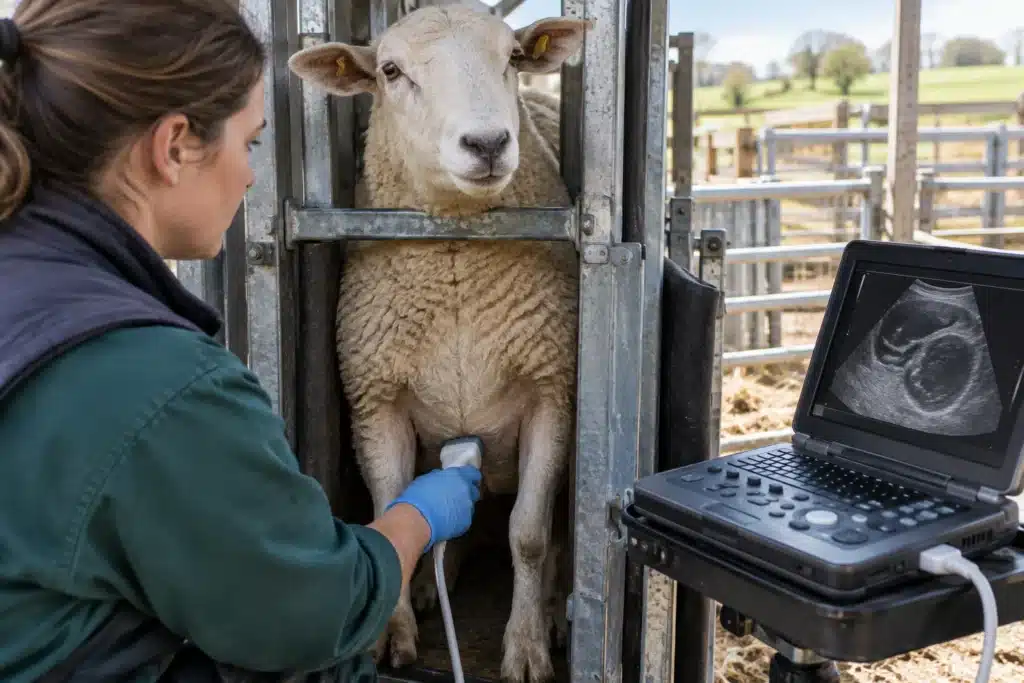
A scan is worth more than a yes-or-no answer. A technician who can see litter size lets you split the flock into groups — singles, twins, triplets, and open ewes — and feed each group according to what she’s actually carrying, instead of feeding every ewe for the worst case or the best case. Scanning too early or too late in the pregnancy changes what shows up on the screen; an operator will tell you the window they need to get an accurate count, and going outside it wastes the trip.
In many sheep-producing areas, mobile ultrasound operators travel a circuit through local flocks around breeding season, scanning on-farm rather than requiring a trip to a clinic. The extension office or a local sheep association is usually the fastest way to find one working near you.
Mid-Pregnancy Signs: Body Condition and Appetite
From roughly the second to third month, a bred ewe starts to show a gradual rounding low in the belly, behind the ribs and ahead of the hip, rather than anywhere on top or across the back. Appetite tends to steady out and weight comes on in that lower-belly region rather than as an even layer of fat over the ribs and loin, which is the main thing that separates pregnancy weight from a ewe that’s simply doing well on pasture or grain.
This is also where most guesswork goes wrong. A ewe that was already carrying extra condition going into breeding can look just as rounded as a pregnant one, and a ewe carrying a single lamb can look barely different from an open ewe at this stage — the belly fill from twins or triplets is what catches the eye, not a single lamb. Looking at the ewe from a distance won’t settle it. Running a hand along the spine and over the loin to score body condition, the same way you’d check condition at weaning or before breeding, gives a more honest read than eyeballing her shape across the pen.
Late-Pregnancy Signs: Udder Development and Belly Shape, Week by Week
From about six weeks out, the signs stop being guesswork and start building in a fairly predictable order. The udder is the most useful marker because it fills on a timeline, not all at once: a small, soft gland six weeks before lambing becomes a tight, visibly larger bag with enlarged teats in the final days. The belly shifts too, dropping lower and widening as the lambs move into position, and the ewe’s activity drops off as she spends more time lying down or standing apart from the group.

Use the table below as a rough guide, not a fixed schedule — breed, litter size, and body condition all shift the timing by several days in either direction.
| Weeks before lambing | Udder stage | Belly shape | Behavior |
|---|---|---|---|
| 5–6 weeks | Small, soft, barely noticeable | Rounded low belly, not yet dropped | Normal grazing and activity |
| 3–4 weeks | Gradual filling, teats starting to firm | Wider, visibly fuller flanks | Slightly less active, still eating well |
| 1–2 weeks | Noticeably larger, firmer bag | Belly dropped, hollow in front of hips | More time lying down, seeking quiet spots |
| Final days | Full, tight, shiny udder | Markedly wide and low, sunken flanks | Restless, isolating from the flock |
Ewe lambs having their first lamb often lag behind this timeline. Their udders can stay small and soft right up until a day or two before lambing, which leads a lot of first-time flock owners to assume a young ewe isn’t close when she actually is. Mature ewes that have lambed before tend to show the stages earlier and more obviously, simply because the udder tissue has already been developed once.
Pro Tip: Plug your breeding dates into the Animals Farming Livestock Gestation Calculator to automatically generate your flock’s expected lambing window and nutrition milestone dates.
Signs Labor Is Near: The Final 24 to 48 Hours
By the time lambing is a day or two away, the late-pregnancy signs described above sharpen into a fairly reliable sequence. Most ewes show them roughly in this order:
- The udder reaches its tightest, shiniest, fullest point, often with the teats standing out and sometimes a little wax or colostrum visible at the tips.
- The vulva relaxes and swells further, and a strand of loose, clear-to-cloudy mucus discharge appears, sometimes hanging for hours before anything else happens.
- The ewe grows restless — up and down repeatedly, shifting position, unable to settle.
- She separates herself from the flock, moving to a corner, a shelter, or a quiet patch of pasture.
- Pawing at the ground and circling follow, the same nesting behavior a ewe uses to flatten out a spot before lying down to push.
- Appetite drops off, often to nothing, in the final hours.
Once strong contractions start, a ewe should be making visible progress within a reasonable stretch of time, not straining on and off for hours with nothing to show for it. A ewe that looks distressed, strains hard without producing a lamb, or shows a leg, head, or tail presenting in a way that doesn’t look like a normal nose-and-two-front-feet position needs a veterinarian on the phone or on the way, not more time to work it out on her own. This is the point in the whole process where watching and waiting stops being the right call.
Mistakes to Avoid When Judging Pregnancy by Eye
A rounded belly is the sign most new flock owners lean on, and it is also the easiest one to misread. A ewe carrying excess body fat, one bloated on lush pasture, or one with a heavy parasite load can all look just as full through the middle as a pregnant ewe, without a lamb anywhere in her. If belly size is the only evidence you have, check how parasite burdens show up in the belly and body condition before you assume pregnancy. The reverse mistake costs just as much: a ewe carrying a single lamb can stay nearly flat-sided until late in the pregnancy, and farmers who wait for an obvious belly change end up skipping the extra feed she actually needs, or culling a ewe that was bred all along.
The real cost shows up in the feed bucket. Ewes carrying twins or triplets need more feed per head in the final weeks than ewes carrying a single lamb, and guessing wrong in either direction costs feed or risks lambing trouble; ask your vet or extension office for the feeding adjustment that fits your flock.
