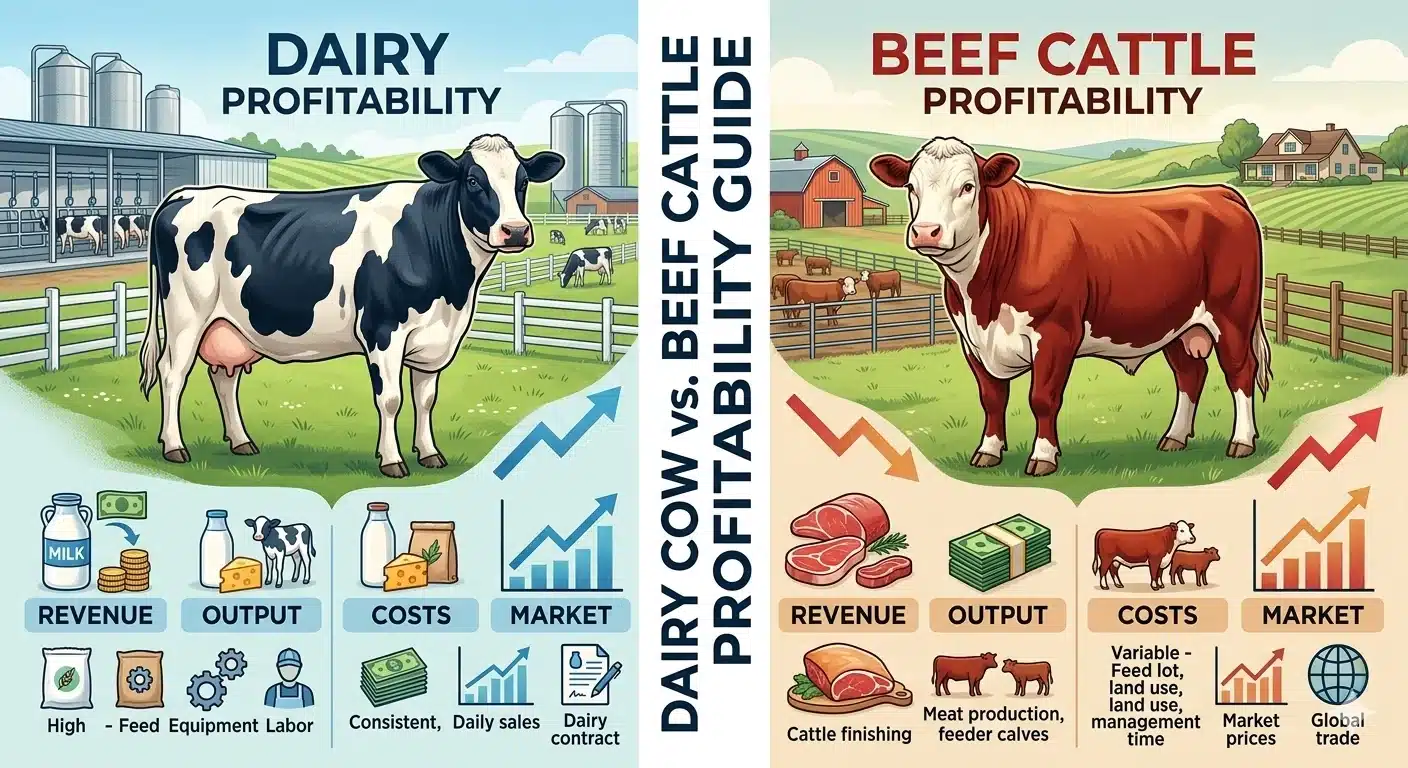
Every few weeks somebody at the feed store or in my messages asks the same thing: should I get a couple of milk cows going or just run a small beef herd instead? I’ve been raising both over the years, and I get why the question keeps coming up. Everybody’s heard the milk check story from a neighbor, and everybody’s heard the fat steer sold for a fair price at the sale barn too. The problem is, most answers people get are mushy. “Dairy’s more work, beef’s more relaxed” is true, but that tells you nothing about your bank account.
So here’s what I’m doing instead. I’m putting real numbers next to each other: what it costs to get started with either one, what a cow actually brings in over a year, and where your margin gets eaten alive before you even notice. I’ve run the math on my own place more than once, tweaking herd size and feed costs to see where the breakeven sits, and the answer isn’t the same for every farm. It depends on your land, your labor, and honestly, how much you like being tied to a milking schedule twice a day, 365 days a year.
By the end of this, you’ll have a clear side-by-side on startup costs, per-head income, and the timing differences that trip up a lot of new farmers — plus my honest take on which one I’d tell a small farm to bet on. If you want to track your own numbers as you go rather than guessing at year-end, a solid farm profit and management guide makes this a lot easier to figure out on your own operation.
Beef Cattle vs Dairy Cattle: What Actually Makes Them Different
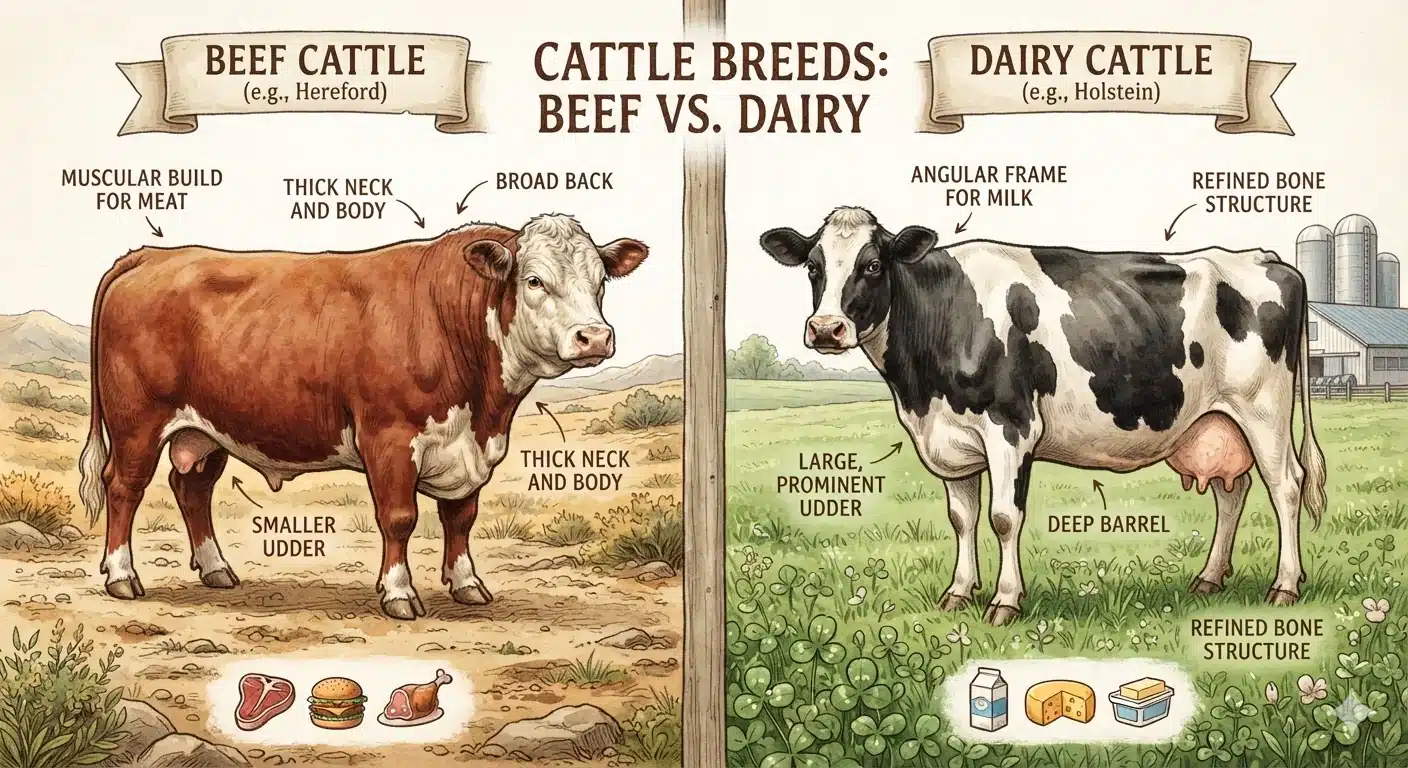
Before you put a dime into either one, you need to understand what you’re actually buying. A beef animal and a dairy animal are the same species, sure, but genetically they’ve been pushed in opposite directions for so many generations that they might as well be built for different jobs entirely. One’s built like a linebacker. The other’s built like a distance runner. That’s not an accident — it’s decades of breeders selecting for exactly that.
Beef breeds like Angus, Hereford, and Charolais carry thick muscle and a good fat cover because that’s the product you’re selling. Dairy breeds like Holstein, Jersey, and Guernsey are lean and angular on purpose, because every extra calorie they eat is supposed to go into the milk tank, not onto their ribs. I’ve had visitors to my place look at my Jerseys and ask if they’re sick. They’re not sick. They’re just doing their job, and their job burns through condition fast.
Body Type and Output Aren’t the Only Split
The difference is more than how they look. A beef cow has one calf each year, and that is her main job on your farm: raise the calf, wean it, get her pregnant again, and do it all over. A dairy cow also needs a calf every year so she keeps making milk, but she also has to give five to eight gallons of milk a day, sometimes more, depending on her breed and how long ago she calved. That is very hard on her body. It changes how much she eats, where she lives, and how fast she gets sick without good care.
This is the part that really surprises a lot of new dairy farmers. A beef cow on good grass can handle a short stretch of poor care. A dairy cow cannot. Skip her minerals or miss the early signs of udder infection (mastitis), and your milk money drops within days, not months. If you pick dairy, I’d learn a good farm animal health management routine before your first cow ever gives birth and starts milking, not after she’s already sick.
Temperament and Handling
Dairy cows are milked twice a day, every day, in the milking barn or stall. Being around people that often makes most dairy breeds calm and gentle; my own Jerseys would almost follow me right into the house. Beef cows, especially if you don’t handle them daily, stay wilder. They only see you a few times a year for shots, weaning, or moving fields, and that’s it. That saves you time, but it means your handling gear cattle chute, head gate, and strong fences must be tougher, because a wild 1,200-pound beef cow with her calf beside her can be dangerous.
| Trait | Beef Cattle | Dairy Cattle |
|---|---|---|
| Body build | Thick, muscled, fat cover | Lean, angular, large udder |
| Common breeds | Angus, Hereford, Charolais, Brahman | Holstein, Jersey, Guernsey |
| Primary product | Meat (one calf/year) | Milk (daily, year-round) |
| Handling frequency | A few times a year | Twice daily minimum |
| Feed demand | Moderate, seasonal peaks | High and constant |
| Tolerance for missed care | Fairly forgiving | Very low, shows up fast |
None of this tells you which one makes more money on your particular acreage. But it explains why the two operations feel so different day to day, and why the cost structure you’re about to look at splits the way it does.
Dairy vs Beef Cattle Startup Costs: What You’re Really Signing Up For
This is where many beginners face hard truths. People price one pregnant young cow, multiply that by how many they want, and call it their full budget. That is way off. The cow herself is often the smallest cost once you count everything she needs to live and make milk or calves on your land.
First, let’s look at the cows. A good pregnant young beef cow, Angus or Angus-cross, due to have her calf in spring costs $1,500 to $2,500, depending on where you live and that year’s prices. A young dairy cow about to calve costs more, often $1,800 to $3,000, and a proven Holstein already milking well can cost even more. Jerseys usually cost a little less than Holsteins, but they are still not cheap animals. Cheap dairy cows are almost always cheap for a reason : a bad udder, poor breeding, or health problems the seller is hiding.
Infrastructure Is Where Dairy Really Separates From Beef
A beef cow needs a fence, a water source, a run-in shed for bad weather, and a chute for handling a few times a year. That’s genuinely most of it. I’ve run beef cattle with nothing fancier than good perimeter fence, a solar waterer, and a portable panel setup I haul out twice a year for shots and weaning.
Dairy is a different animal, literally and financially. You need a parlor or, at minimum, a stanchion setup, a bulk tank to chill milk fast and hold it at temperature, and a clean, dry area for milking that meets whatever your state requires if you’re selling milk commercially. Even a two-cow home dairy setup with a small bulk tank and basic milking equipment can run $3,000 to $8,000 before you’ve bought a single cow. Scale up to a real commercial parlor, and you’re into five and six figures fast.
| Startup Item | Beef Cattle (per head/setup) | Dairy Cattle (per head/setup) |
|---|---|---|
| Bred female, average quality | $1,500 – $2,500 | $1,800 – $3,500 |
| Fencing (perimeter + cross-fence) | $1,500 – $4,000 | $1,500 – $4,000 |
| Shelter/housing | $800 – $2,500 (run-in shed) | $3,000 – $10,000+ (barn, stalls) |
| Milking equipment/bulk tank | Not needed | $3,000 – $8,000 (small setup) |
| Handling equipment (chute/headgate) | $800 – $2,500 | $800 – $2,500 |
| Annual feed cost per head | $300 – $700 | $900 – $1,600 |
Feed is the other gap that catches people off guard. A beef cow on decent pasture with hay through winter costs you somewhere in the $300 to $700 a year range, depending on your hay prices and how long your grazing season runs. A milking dairy cow needs pasture or hay plus a real grain ration to support that daily output, and that pushes annual feed costs to $900, sometimes $1,600 or more per cow, especially for a high-producing Holstein in peak lactation.
Land and Labor Costs Add Up Differently Too
Beef cattle are more forgiving on acreage. You can run a cow-calf pair on 1.5 to 2 acres of good pasture in most regions and supplement hay when grass runs thin. Dairy cows need that same grazing base but also need to be close to the barn twice a day, every day, which limits how far you can rotate them and adds fencing complexity if you’re doing management-intensive grazing.
Labor is the cost that never shows up on paper but absolutely shows up in your life. Beef cattle take a few hours a week outside of calving season. Dairy cattle take two hours a day, minimum, seven days a week, fifty-two weeks a year. No vacation, no sick days unless you’ve got someone trained to cover the parlor. I tell people considering dairy to actually milk someone else’s cows for two weeks straight before they buy a single animal. It changes the calculation fast.
None of these numbers mean much in isolation. What matters is tracking them against what each animal actually pays you back, and that’s where a lot of small operations lose money without ever realizing it — they never separate feed cost per cow from income per cow, so a marginal animal blends into the herd average. Running your startup numbers through a proper farm accounting system from day one, instead of a shoebox of receipts, is the difference between knowing your real cost per head and guessing at it.
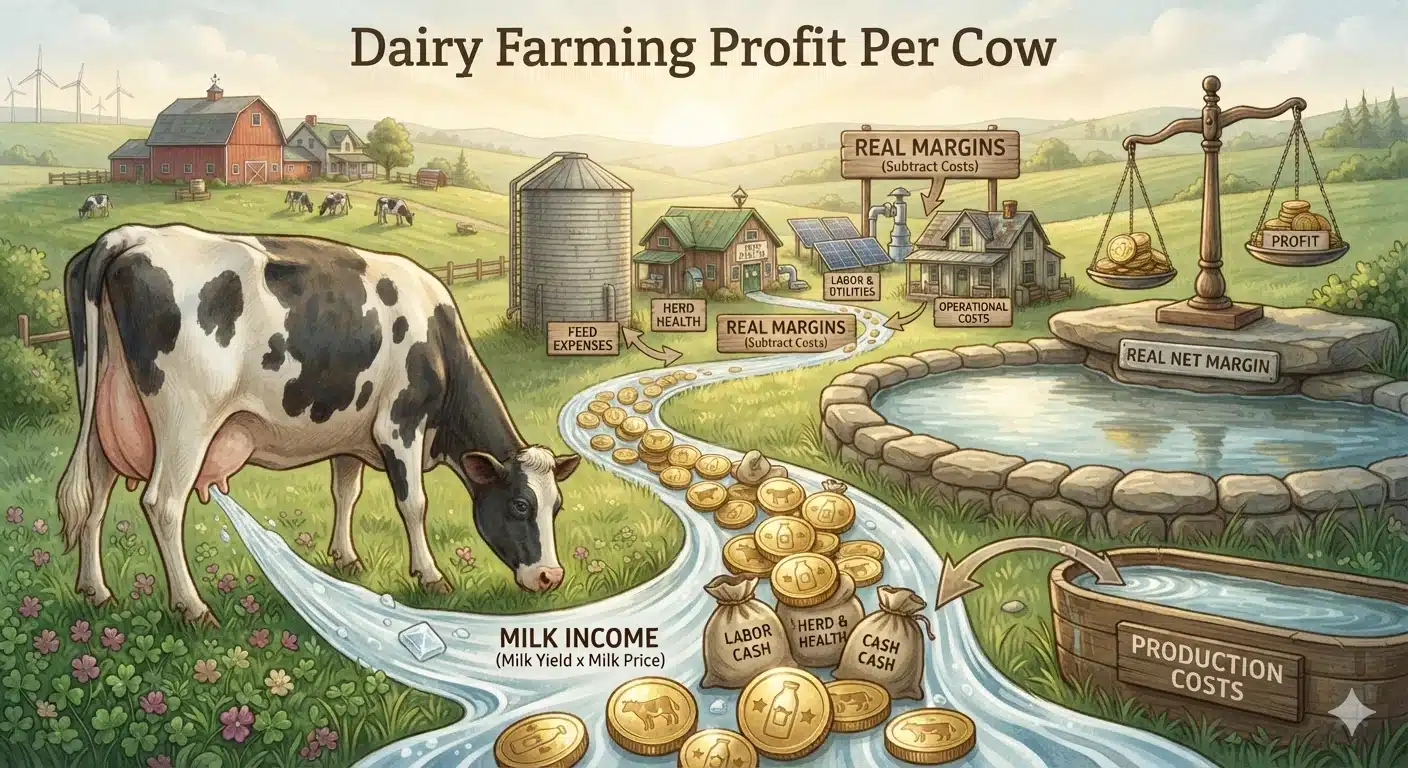
Dairy Farming Profit Per Cow: Milk Income and Real Margins
This is the section where dairy looks amazing on paper and then humbles you six months in. A good Holstein can pump out 70 to 90 pounds of milk a day at peak lactation, roughly 8 to 10.5 gallons. A Jersey gives you less volume, maybe 40 to 60 pounds a day, but her milk runs higher in butterfat and protein, which matters a lot if you’re selling to a creamery paying on components rather than straight volume. Either way, that’s real income hitting your account daily, not once a year at a sale barn. That’s the part everyone falls in love with.
Here’s the part they don’t love as much. Feeding a cow to produce that milk isn’t cheap, and the margin between what she costs to feed and what her milk sells for is a lot thinner than the gross number suggests.
What a Milking Cow Actually Nets You
Let’s run real numbers on a Holstein averaging 70 pounds a day, sold as raw fluid milk at a farm-gate price. I’m using round figures here because milk prices swing hard by region and by year, but the math structure holds no matter what your local price is.
| Category | Per Cow, Per Year (Approx.) |
|---|---|
| Milk sold (fluid, farm-gate price) | $2,800 – $4,200 |
| Annual feed cost | $900 – $1,600 |
| Vet care, hoof trimming, breeding costs | $250 – $450 |
| Bedding, utilities, parlor supplies (per cow share) | $150 – $350 |
| Labor (your time, valued conservatively) | $600 – $1,000+ |
| Rough net margin per cow, per year | $400 – $1,200 |
That net margin range is wide on purpose, because it moves fast depending on where you sell. Bottled milk sold direct to consumers or through a small creamery pays multiples of what a bulk commodity check pays. If you’ve got the licensing and the customer base for raw milk sales or an on-farm creamery, your per-cow number can beat that top figure by a wide margin. Sell into a commodity co-op with no premium, and you can slide toward the bottom of that range or even below it in a bad milk-price year.
I’ve said this to plenty of people starting and, I’ll say it here too: the cow herself is rarely the reason dairy margins go bad. It’s almost always feed cost creeping up unnoticed, or a somatic cell count problem that quietly knocks your milk into a lower price tier for months before anyone catches it. Small dairies lose more money to slow-moving problems like that than to any single disaster.
The Costs That Eat Your Margin Without Announcing Themselves
A few things quietly drag dairy profit down that beef producers never deal with at all.
- Dry period costs — you feed her for roughly 60 days with zero milk income while she preps for the next calving.
- Mastitis and udder health — treat it wrong or catch it late and you’re dumping milk, paying vet bills, and sometimes losing the quarter permanently. Our mastitis guide covers what to watch for before it costs you real money.
- Breeding downtime — a cow that doesn’t settle on schedule pushes her whole lactation cycle back, and that’s income you don’t get back.
- Replacement heifer cost — dairy cows cycle out faster than beef cows on average, so you’re always raising or buying the next one.
None of this means dairy doesn’t pay. It absolutely can, and a well-run two- to four-cow home dairy selling raw milk, cheese, or butter direct to neighbors often nets better per-cow returns than any beef operation I’ve seen at that scale. But that number only holds if you’re actually tracking milk yield and cost per cow separately, not lumping the whole herd into one average and hoping it works out. A cow quietly dragging your average down for a full lactation can cost you more than a full year of a beef cow’s feed bill, and you’d never know it without real numbers in front of you. That’s exactly the kind of gap a proper yield tracking system catches early instead of six months late.
Beef Cattle Income Per Head: Costs, Payouts, and Timing
Beef is the opposite animal, in every sense. You don’t get a check every week. You get a check once, maybe twice a year, and everything you spent the other ten months feeding that animal comes due on sale day. That’s a hard adjustment for anyone coming from a job with a regular paycheck, and it’s the number one reason new beef producers panic around month eight when the bank account looks thin, and the calves are still six weeks from weight.
A cow-calf operation running Angus, Hereford, or an Angus-Charolais cross typically weans calves at 6 to 8 months old, somewhere around 450 to 600 pounds depending on breed, milk supply from the dam, and how good your pasture was that year. From there you’ve got three paths: sell straight off the cow as a weaned calf, background them another 90 to 120 days to add weight before selling, or finish them yourself to slaughter weight around 1,100 to 1,300 pounds. Each path changes your timeline and your margin completely.
What a Cow-Calf Pair Actually Costs You Per Year
Here’s the annual cost of keeping one beef cow and getting one calf to weaning, using pasture-based numbers common on a small operation feeding some hay through winter.
| Category | Per Cow, Per Year (Approx.) |
|---|---|
| Hay and supplemental feed (winter months) | $300 – $600 |
| Mineral, vaccines, deworming | $80 – $150 |
| Vet care and breeding costs (bull share or AI) | $100 – $250 |
| Fencing, water, general upkeep (per cow share) | $50 – $120 |
| Labor (your time, valued conservatively) | $200 – $400 |
| Total annual cost per cow | $730 – $1,520 |
Now stack that against what the calf actually brings. A 550-pound weaned steer calf sold at a local sale barn will fetch a price that swings hard with the market, but a rough working range most years lands the gross income for that single calf somewhere between $700 and $1,300. Subtract your annual cow-keep cost, and you’re netting anywhere from a couple hundred dollars to around $700 per cow, per year. Some years, in a strong calf market, that number climbs well past that. Some years, in a weak one, you barely clear your feed bill.
That’s the honest range. Anyone quoting you a fixed number without asking what your local sale barn is paying this month is guessing.
Where the Timing Actually Bites You
The gap between spending money and making money is the single biggest thing people underestimate about beef. You’re feeding that cow every single day of the year. You get paid once, on the day the calf sells. If you’re financing land, equipment, or the cows themselves, that ten-to-twelve month gap between outlay and payout needs to be planned for in cash, not hoped for.
- Weaning timing matters a lot — calves weaned too early are lighter and sell for less per head, even if the per-pound price looks decent.
- Market timing swings your payout by hundreds of dollars per animal depending on the week you sell, not just the year.
- Health events around weaning and transport hit beef calves hard — shipping stress is a real cause of respiratory trouble, and our guide on bovine respiratory disease in cattle is worth reading before your first sale day, not after a calf gets sick on the truck.
- Backgrounding or finishing calves yourself instead of selling straight off the cow can add real money per head, but it also adds 90 to 200+ days of feed cost before you see that money.
Where you sell matters just as much as when, a weaned calf sold direct to a neighbor or through an online listing can beat sale barn price once you cut out the middleman and the trucking stress, and checking a proper livestock marketplace before committing to your local auction house is worth the extra hour it takes.
None of this makes beef a bad choice. It just makes it a patient one. You need cash reserves to carry you through the months with no income, and you need to actually track your cost per cow instead of assuming the calf check will cover whatever you spent. Producers who skip that tracking step are the ones who tell you beef doesn’t pay, when really they just never found out where their money went.
Dairy Cow vs Beef Cattle Profitability: Side-by-Side Numbers
Numbers side by side settle more arguments than opinions do. So here’s the same year, the same size operation, one dairy cow and one beef cow, laid out next to each other. These are approximate ranges built from what we’ve walked through above, not a promise of what your farm will do. Your feed costs, your milk buyer, your local sale barn- all of it shifts these numbers up or down.
| Factor | Dairy Cow | Beef Cow (Cow-Calf) |
|---|---|---|
| Typical startup cost per animal | $1,800 – $3,500 | $1,200 – $2,500 |
| Annual keep cost per animal | $1,400 – $2,200 | $730 – $1,520 |
| Income frequency | Weekly or biweekly (milk check) | Once or twice a year (calf sale) |
| Gross income per animal, per year | $2,200 – $4,000+ | $700 – $1,300 per calf |
| Rough net profit per animal, per year | $500 – $1,200 | $200 – $700 |
| Time from purchase to first payout | 0 – 60 days if already lactating | 10 – 12 months |
| Daily labor demand | High, twice-daily milking | Low to moderate, daily checks |
| Cash flow pattern | Steady, predictable | Lumpy, seasonal |
Look at that net profit row, and the dairy cow wins on paper, most years. But that number comes with a catch beef doesn’t have: you have to milk that cow every single day, twice a day, or the whole thing falls apart within 24 hours. Miss a milking on a beef cow, and nothing happens. Miss two milkings on a dairy cow and you’re dealing with mastitis and a vet bill that eats a month of profit.
Beef looks weaker on the yearly net number, and it is weaker most years, dollar for dollar per animal. What the table doesn’t show is how much less it asks of you day to day. A beef cow needs water, mineral, and a fence check. A dairy cow needs a parlor, a schedule you can’t skip, and usually a second person when you’re sick, or it’s calving season for both jobs at once.
Scale changes this comparison hard, too. Five dairy cows can run a small farm’s grocery bill and then some, sold as raw milk, cheese, or a herd share arrangement, if your state allows it. Five beef cows barely cover a truck payment most years. But fifty beef cows on decent pasture with low labor input can out-earn fifty dairy cows that would need a parlor, hired labor, and a cooling tank most small farms can’t justify building.
None of these ranges mean anything if you’re not tracking your own numbers against them. I’ve seen farmers guess at their margins for years and get it wrong in both directions, some thinking they’re losing money when they’re actually fine, others thinking they’re profitable when the feed bill alone is eating every dollar the calves bring in. A proper farm accounting habit, even a simple spreadsheet updated weekly, tells you which side of these ranges you’re actually sitting on.
Which One Should You Actually Raise? My Take for Small Farms
Here’s where I stop being neutral. If you’re brand new to cattle, have a day job, and can’t be home at 5 a.m. and 5 p.m. every single day, including Christmas and your kid’s birthday, get beef cattle. Not dairy. I don’t care how good the margins look on paper. A dairy cow doesn’t care that you’re sick, that your truck broke down, or that you overslept. She needs milking, and if you can’t do that reliably, you shouldn’t own her.
Beef cow-calf pairs forgive mistakes. You can miss a day of close observation and nothing bad happens most of the time. You can go on vacation for a weekend if a neighbor tosses out hay and checks water. Try that with a milking herd, and you’ll come home to a mastitis outbreak and a very unhappy cow.
That said, I wouldn’t talk a motivated, home-based family out of one or two dairy cows. A single Jersey, sold as a herd share or just feeding your own household, pays for herself fast in raw milk, butter, and cheese you’d otherwise buy at the store. The math on a family milk cow isn’t really about profit margin; it’s about replacing a grocery bill with better product. That’s a different game than running cattle as an income stream.
For anyone asking which one to raise as an actual business, my answer depends on three things: how much labor you’ve got, how much land you’ve got, and how fast you need cash back.
- Short on labor, long on pasture: go beef. Cow-calf pairs on grass with minimal grain input are about as low-maintenance as livestock get.
- Short on land, willing to work daily: dairy pays more per acre and per animal, if you’ve got a buyer lined up before the cow ever freshens.
- Need income in the first 90 days: dairy, hands down. Beef makes you wait 10 to 12 months minimum for a payout, and that’s brutal if you’re counting on the farm to cover bills soon.
- Want to scale past a hobby into real acreage and real numbers: beef scales easier. Fifty cow-calf pairs is a manageable operation for one or two people. Fifty milking cows need a parlor, hired help, and a whole different level of infrastructure spend.
My own bias, if I’m honest, leans beef for most beginners. The learning curve is gentler, the mistakes cost less, and the daily grind won’t burn you out in year two. Dairy is the better dollar-for-dollar earner most years, but it demands a level of commitment that a lot of new farmers underestimate until they’re three months in and exhausted.
Whichever side you land on, don’t run either operation on gut feel. Track your feed costs, your vet bills, your sale prices, and your labor hours against the ranges we’ve laid out here, every month, not just at tax time. A proper farm management system makes that tracking automatic instead of another chore you keep putting off, and it’s the difference between guessing at your margins and actually knowing them.
