
If you are looking for a meat goat breed, the Boer goat is one of the best-known choices for high-quality meat production. It is valued for its fast growth, strong muscling, and good carcass quality.
However, being a good meat-producing breed does not necessarily mean it is the right choice for every farm. Your farming conditions, management, budget, and production goals all matter.
This complete guide covers Boer goat characteristics, meat production, feeding and farm management, costs, advantages and disadvantages, and other important information to help you understand the breed before starting a Boer goat farm.
What Is a Boer Goat?
The Boer goat is a goat breed specifically valued for rapid growth, excellent productivity, good carcass quality, and efficient meat production. Unlike dairy goats, which are primarily bred for milk, Boer goats are mainly raised for high-quality meat production.
The breed is particularly known for its:
- Fast growth rate
- Strong meat-producing ability
- Excellent carcass characteristics
- Good reproductive performance
Boer goats are widely used in commercial meat production, breeding programs, and crossbreeding to improve growth and meat characteristics in goat herds.
The History of Boer Goats
Boer goats originated in South Africa, with their development linked to indigenous African goats and the influence of Indian, Angora, and European dairy goats. The exact genetic origin is not completely clear, but indigenous populations associated with the Namaqua Hottentots and Bantu tribes are believed to have contributed to the breed.
The modern Boer goat emerged in the early 1900s, when farmers in South Africa’s Eastern Cape began selectively breeding goats for meat production. The name “Boer” comes from the Dutch word boer, meaning “farmer,” reflecting the breed’s development by South African farmers.
Over time, Boer goats became established as a specialized meat-goat breed and were later introduced to other countries including Australia, New Zealand, the United States, and Canada, where they became widely used in both purebred production and Boer goat crossbreeding programs.
Boer Goat Characteristics:
Boer goats are known for their fast growth, strong muscling, good body conformation, and adaptability. These characteristics make them well suited to meat production and different farming conditions.
Boer goat weight and size
Boer goats are a large meat-goat breed with a strong, well-developed body. Adult males are generally heavier than females; therefore, Boer goat weight varies for Boer buck ( male) and Boer doe ( female ) goats
| Type | Typical Adult Boer goat Weight |
| Doe (female) | 90–105 kg (200–230 lb) |
| Buck (male) | 110–135 kg (240–300 lb) |
Rapid growth is observed in nutrition and management, although growth varies with genetics, feed, age, and management.

Body Conformation and Appearance
Boer goats have a large, well-muscled body designed for meat production. They typically have a broad chest, deep body, strong back, and heavy hindquarters. Their strong bone structure and muscular frame contribute to good carcass development.
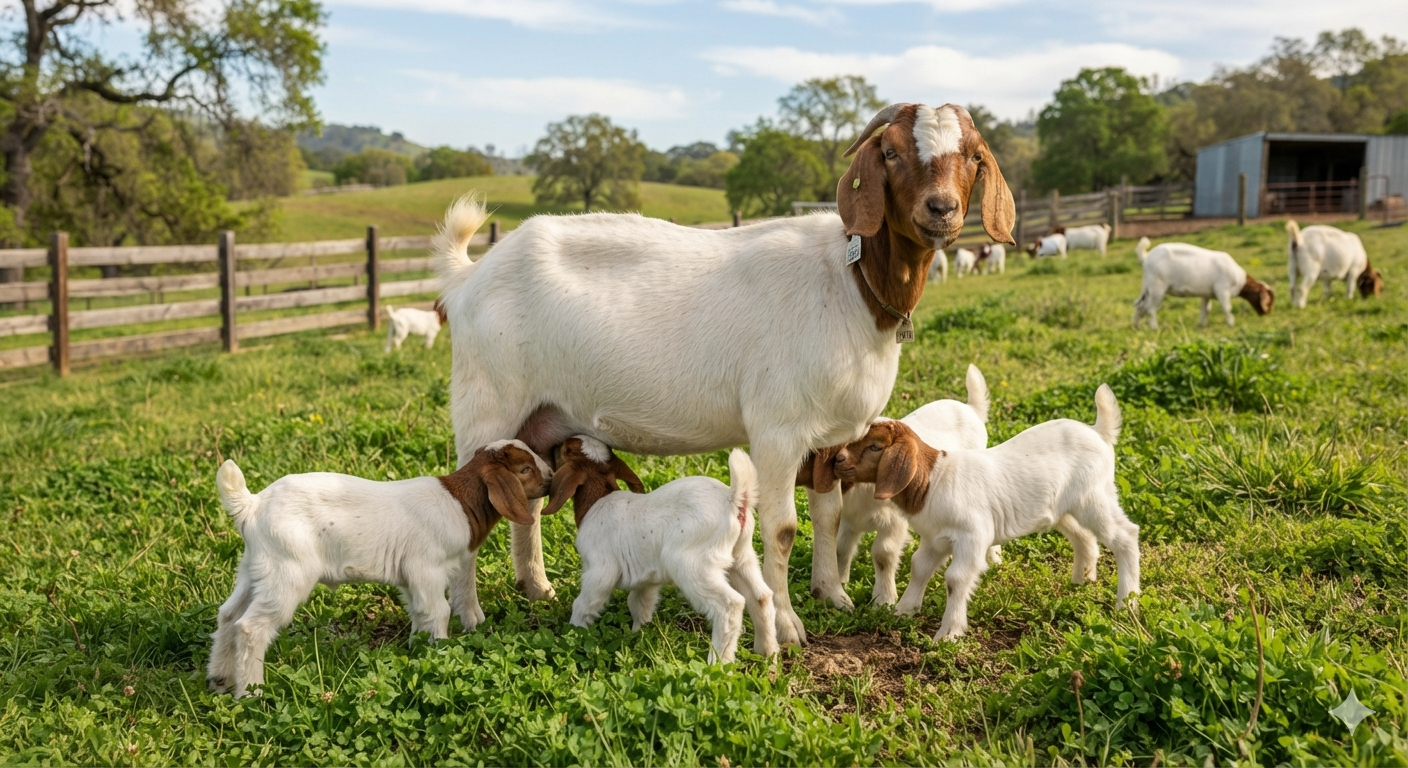
The typical Boer goat has a white or cream-colored body with a red or reddish-brown head and neck. However, coat colors can vary, and red Boer goats and black Boer goats are also found. Some animals may have different combinations of these colors.
Their long, pendulous ears, prominent horns, strong legs, and muscular body are also characteristic features of the breed.
Temperament
Boer goats are generally calm and manageable, although mature bucks may become more territorial or aggressive during the breeding season. Proper handling and housing are therefore important when keeping breeding males.
Why Boer Goats Are One of the Best Meat Goat Breeds
Fast growth, strong muscling, good carcass quality, and good reproduction make the Boer goat one of the best breeds for meat.
Growth Rate and Meat Production
Fast growth is one of the main characteristics of Boer goats, making them well suited for meat production. Under good feeding and management, Boer goats can gain around 150–200 g per day, with exceptional animals exceeding 200 g. Their rapid growth, large frame, and strong muscling help them reach market weight efficiently and produce well-developed carcasses with good meat yield.
Reproductive Performance
Boer goats are known for good fertility and reproductive performance. Does have good maternal ability and regularly produce twins or multiple kids, helping farmers increase the number of marketable animals within a herd.

Hardiness and Adaptability
Boer goats are adaptable animals that can perform under different production conditions. They can use pastures, cultivated grazing areas, bush, and rough terrain, making them useful in areas where other livestock may have difficulty finding adequate forage.
Browsing and Feeding Behavior
Boer goats are predominantly browsers, meaning they naturally seek leaves, shrubs, bushes, and other woody vegetation rather than relying only on grass. This allows them to make good use of rough or bushy grazing areas. They can also perform well under more intensive feeding systems when provided with adequate nutrition.
Boer Goat Pros and Cons
Boer goats can be highly productive for meat farming, but they also require a suitable budget and consistent management. The table below compares their main advantages with the practical challenges that come with them.
| Pros | Cons |
|---|---|
| Fast growth and early weight gain | Higher purchase cost than many local breeds |
| Strong muscling and good carcass yield | Higher feed requirements to support rapid growth |
| Good fertility and reproductive performance | Parasite risk requires regular monitoring and control |
| Adaptable to different farming conditions | Breeding bucks require careful handling, especially during breeding season |
| Good for crossbreeding to improve size and meat production | Purebred breeding stock can be expensive |
| Strong meat-production potential | Requires consistent management to achieve its full production potential |
Overall, Boer goats can be highly productive meat animals, but their advantages are best achieved with good nutrition, breeding, parasite control, and general herd management.
Boer Goat Doe vs. Boer Buck: Key Differences
- Bucks are generally larger, heavier, and more heavily muscled, whereas does have a comparatively smaller frame.
- The main difference is their role in the herd. Bucks are primarily used for breeding and passing desirable genetics to their offspring. Does are responsible for pregnancy, kidding, and raising the young, making them the foundation of a breeding herd.
- Their nutritional needs also differ. Bucks require more feed because of their larger size, while does need additional nutrition during pregnancy and lactation to support their own condition and the growth of their kids.
- In terms of temperament, does are generally easier to handle. Mature bucks can become more territorial or aggressive during the breeding season and therefore require careful handling and housing.
- For meat production, both males and females can be raised for meat, but bucks generally reach a larger mature size and develop heavier muscling. For breeding, a good buck is particularly important because one male can breed several does and influence the growth, size, and muscling of many offspring.
- In simple terms, does produce and raise the kids, while bucks contribute the genetics that shape the next generation.
Buck Breeding Readiness and Age
Boer bucks are generally ready to breed at 12–14 months of age, although they can reach sexual maturity earlier. However, breeding them too young can affect their growth and long-term performance. At 12–14 months, a well-grown buck has the size and maturity to breed does successfully without compromising his own development.
One buck can service multiple does during the breeding season, which is why a single good-quality breeding male can have a significant impact on your herd. That’s also why bucks generally cost more than does — one male can produce dozens of offspring in a season.
Buck Breeding Readiness and Age
Boer bucks are generally ready to breed at 12–14 months of age, although they can reach sexual maturity earlier. However, breeding them too young can affect their growth and long-term performance. At 12–14 months, a well-grown buck has the size and maturity to breed does successfully without compromising his own development.
One buck can service multiple does during the breeding season, which is why a single good-quality breeding male can have a significant impact on your herd. That’s also why bucks generally cost more than does — one male can produce dozens of offspring in a season.

Requirements for Boer Goat Farming Management
Successful Boer goat farming depends on providing the right feed, housing, health care, breeding management, and farm space. Each area should be planned according to the size of the herd and the local climate.
Feeding and Water
Good nutrition is essential for maintaining Boer goats’ rapid growth, muscle development, reproductive performance, and overall health.
- Provide pasture, browse, or good-quality hay as the main forage.
- Use concentrate feed when forage alone cannot meet nutritional needs.
- Provide minerals and salt according to local requirements.
- Keep clean water available and check water sources regularly.
- Increase feed quality for growing kids, pregnant does, and lactating does.
Housing and Fencing
Housing does not need to be complicated, but it should keep goats dry, secure, and protected from severe weather.
- Provide enough covered space for the entire herd.
- Keep floors and bedding dry to reduce disease problems.
- Ensure good airflow and avoid overcrowding.
- Provide shade in hot weather and protection from cold or heavy rain.
- Use strong fencing and secure gates, particularly for active breeding bucks.
Health Management
A preventive health program is more effective than waiting for goats to become sick.
- Follow a vaccination program suitable for local diseases.
- Monitor goats regularly for parasites, poor body condition, and illness.
- Use de-wormers based on need and veterinary or local livestock guidance rather than routine overuse. Parasite pressure is typically highest in warm, wet months, so monitor animals closely during summer and deworm strategically before the breeding season.
- Trim overgrown hooves when necessary.
- Isolate sick or newly purchased goats before mixing them with the main herd.
Breeding and Herd Management
Breeding decisions have a direct effect on the future quality and productivity of the herd.
- Choose breeding animals based on health, conformation, growth, and reproductive performance.
- Keep an appropriate number of does for each breeding buck.
- Record mating dates, kidding dates, parentage, and important health information.
- Give pregnant and nursing does additional nutritional support.
- Remove animals with poor reproductive performance or serious inherited problems.
Breeding Soundness Exams for Bucks
Before the breeding season, it’s worth having your buck evaluated by a veterinarian, particularly if he’s valuable or you’re planning to use him heavily. A breeding soundness exam (BSE) has two main components: structural soundness and semen quality.
The structural evaluation checks legs, feet, body condition, and overall health. The semen check evaluates sperm count, motility, and abnormalities. Both are important because a buck can look healthy but still have fertility problems that won’t show up until you realize your does aren’t settling.
Schedule the exam 4–6 weeks before the breeding season starts. That gives you time to replace the buck or adjust your breeding plan if there’s a problem.
Pre-Breeding Preparation
Getting bucks and does ready before breeding starts will improve your results. For bucks, deworm them before turnout to reduce parasite loads during the breeding period. Trim their hooves 2–3 weeks before breeding — not right before — so any soreness from trimming has time to heal. You want the buck moving comfortably when he’s working.
Keep bucks in good body condition, but not overly fat. A buck that’s too heavy may have reduced stamina and fertility.
Does should also be dewormed and brought to proper body condition before breeding. If you’re running multiple bucks or planning to use specific sire groups, pen does together by their assigned buck several weeks before breeding starts. This lets them establish their pecking order before the buck arrives, reducing stress and fighting during the actual breeding period.
Health Events and Buck Fertility
Illness and high fever can temporarily reduce a buck’s semen quality and sperm count. If your buck gets sick or runs a fever within two months of breeding season, his fertility may be affected for several weeks afterward. Sperm production takes time, so a health problem today can show up as poor conception rates a month later.
This is another reason to work with a veterinarian who knows your herd and your breeding schedule. A vet-client relationship built over time means better advice when problems come up.
Breeding Soundness Exams for Bucks
Before the breeding season, it’s worth having your buck evaluated by a veterinarian, particularly if he’s valuable or you’re planning to use him heavily. A breeding soundness exam (BSE) has two main components: structural soundness and semen quality.
The structural evaluation checks legs, feet, body condition, and overall health. The semen check evaluates sperm count, motility, and abnormalities. Both are important because a buck can look healthy but still have fertility problems that won’t show up until you realize your does aren’t settling.
Schedule the exam 4–6 weeks before the breeding season starts. That gives you time to replace the buck or adjust your breeding plan if there’s a problem.
Pre-Breeding Preparation
Getting bucks and does ready before breeding starts will improve your results. For bucks, deworm them before turnout to reduce parasite loads during the breeding period. Trim their hooves 2–3 weeks before breeding — not right before — so any soreness from trimming has time to heal. You want the buck moving comfortably when he’s working.
Keep bucks in good body condition, but not overly fat. A buck that’s too heavy may have reduced stamina and fertility.
Does should also be dewormed and brought to proper body condition before breeding. If you’re running multiple bucks or planning to use specific sire groups, pen does together by their assigned buck several weeks before breeding starts. This lets them establish their pecking order before the buck arrives, reducing stress and fighting during the actual breeding period.
Health Events and Buck Fertility
Illness and high fever can temporarily reduce a buck’s semen quality and sperm count. If your buck gets sick or runs a fever within two months of breeding season, his fertility may be affected for several weeks afterward. Sperm production takes time, so a health problem today can show up as poor conception rates a month later.
This is another reason to work with a veterinarian who knows your herd and your breeding schedule. A vet-client relationship built over time means better advice when problems come up.
How Much Do Boer Goats Cost?
The price of a Boer goat depends mainly on its age, sex, genetics, breeding quality, registration status, and location. Commercial goats are generally less expensive than animals selected for breeding.
Typical Boer Goat Prices
| Type | Typical Price Range (USD) |
| Boer Kids | $150–$400 |
| Boer Does | $300–$800+ |
| Boer Bucks | $500–$2,000+ |
| Registered/Show-Quality | $1,000–$5,000+ |
These are general market ranges, not fixed prices. Local prices can be significantly different, particularly in countries where Boer goats are less widely available.
What Affects Boer Goat Price?
- Genetics and bloodline: Goats from proven bloodlines usually cost more.
- Age and sex: Healthy breeding-age bucks and does are often more expensive.
- Registration: Registered goats with verified pedigrees usually have a higher price.
- Health and condition: Healthy, well-developed goats are more valuable.
- Breeding history: Goats with a proven record of successful breeding may cost more.
- Location and demand: Prices change depending on local availability and buyer demand.
- Vaccination status: Goats with a full vaccination history are healthier, less risky, and usually priced higher than unvaccinated animals.
- Gender and reproductive value: Bucks generally cost more than does because one buck can breed many does in a season, multiplying his genetic influence across the herd.
- Vaccination status: Goats with a full vaccination history are healthier, less risky, and usually priced higher than unvaccinated animals.
- Gender and reproductive value: Bucks generally cost more than does because one buck can breed many does in a season, multiplying his genetic influence across the herd.
Are Boer Goats a Good Choice for Your Farm?
Boer Goats Compared to Other South African Meat Breeds
Boer goats aren’t the only meat breed available, particularly in South Africa where several other breeds have been developed for similar purposes.
Savanna goats are white, heat-tolerant, and known for hardiness and good mothering ability. They perform well in hot, dry conditions and are often chosen for tougher environments.
Kalahari Red goats are solid red, bred for meat production in arid regions, and valued for their ability to handle sparse grazing and harsh climates.
Both Savanna and Kalahari Red goats are excellent meat animals. The main reasons to choose Boer over these breeds are availability, personal preference, and established market demand. Boer goats have the widest international recognition and the largest genetic pool, which can matter if you’re breeding for export or want access to a broad selection of bloodlines.
For most small to mid-scale meat operations, any of these three breeds will perform well if managed properly. The choice often comes down to what’s available locally and what fits your farm conditions.
Boer Goats Compared to Other South African Meat Breeds
Boer goats aren’t the only meat breed available, particularly in South Africa where several other breeds have been developed for similar purposes.
Savanna goats are white, heat-tolerant, and known for hardiness and good mothering ability. They perform well in hot, dry conditions and are often chosen for tougher environments.
Kalahari Red goats are solid red, bred for meat production in arid regions, and valued for their ability to handle sparse grazing and harsh climates.
Both Savanna and Kalahari Red goats are excellent meat animals. The main reasons to choose Boer over these breeds are availability, personal preference, and established market demand. Boer goats have the widest international recognition and the largest genetic pool, which can matter if you’re breeding for export or want access to a broad selection of bloodlines.
For most small to mid-scale meat operations, any of these three breeds will perform well if managed properly. The choice often comes down to what’s available locally and what fits your farm conditions.
Boer goats are a good choice for farms that aim to produce quality meat and build a productive breeding herd. However, their suitability depends on the farm’s resources, management system, budget, and production goals.
Boer goats may be a good fit if you:
- Want to produce goats primarily for meat
- Plan to establish or expand a breeding herd
- Have access to suitable pasture, browse, or supplemental feed
- Have or can build proper housing infrastructure — goats need dry, secure shelter and well-planned pens
- Have or can build proper housing infrastructure — goats need dry, secure shelter and well-planned pens
- Can provide regular health and parasite management
- Want to use Boer goats for crossbreeding to improve growth and muscling
They may not be the best choice if you:
- Want livestock requiring very little management
- Have limited access to adequate feed and grazing
- Are mainly interested in milk production
- Do not want the responsibilities of breeding and herd management
- Cannot afford the higher initial cost of quality breeding animals
- Don’t have the space or budget to build adequate goat housing and fencing
- Don’t have the space or budget to build adequate goat housing and fencing
Where to Buy Boer Goats
Boer goats can be purchased from reputable breeders, livestock farms, livestock markets, auctions, and online livestock marketplaces. Buying directly from an established breeder is often useful because you can learn about the goat’s genetics, health history, age, and breeding record.
Before buying, evaluate both the animal and the seller. Check the goat’s body condition, activity level, eyes, coat, legs, and overall health. For breeding animals, ask about pedigree, vaccination records, previous breeding performance, and any history of disease.
The seller’s reputation is equally important. Choose a breeder or farm that is transparent about the animal’s background and allows you to inspect the goat before purchase. Avoid choosing an animal based on size or appearance alone; its health, genetics, and suitability for your farming purpose are more important.
Regular health checkups are essential to prevent common diseases of goat and sheep that can affect your Boer goat herd.
Proper vaccination and disease prevention in goats will help maintain a healthy and profitable Boer goat farm.
