
Reviewed by Dr Rehana Ishaq, November 28, 2026.
Barber pole worm is a blood-sucking stomach worm that causes anemia, bottle jaw and sudden death in goats and sheep, especially in warm, wet weather. It is the most damaging internal parasite of small ruminants in most farming regions, and it can kill an animal before any obvious sign appears. Barber pole worms in goats are usually the bigger problem, because goats build less immunity than sheep. The good news is that farmers who check their animals regularly, treat only the ones that need it, and manage their pasture can keep it under control.
This guide explains what the barber pole worm is, how goats and sheep pick it up, the symptoms to watch for, how to check for it with the FAMACHA eye score, how treatment works, and how to prevent it on your pasture.
Key facts at a glance
- Scientific name: Haemonchus contortus. It lives in the abomasum, the fourth (true) stomach.
- Who it hits hardest: goat kids, lambs, and does and ewes around kidding and lambing.
- Main sign: anemia, which shows as pale eyelids, weakness and, in bad cases, bottle jaw.
- Speed: a heavy infection can kill within a week.
- Best tools: FAMACHA eye scoring, the Five Point Check, fecal egg counts and pasture management.
What Is a Barber Pole Worm?
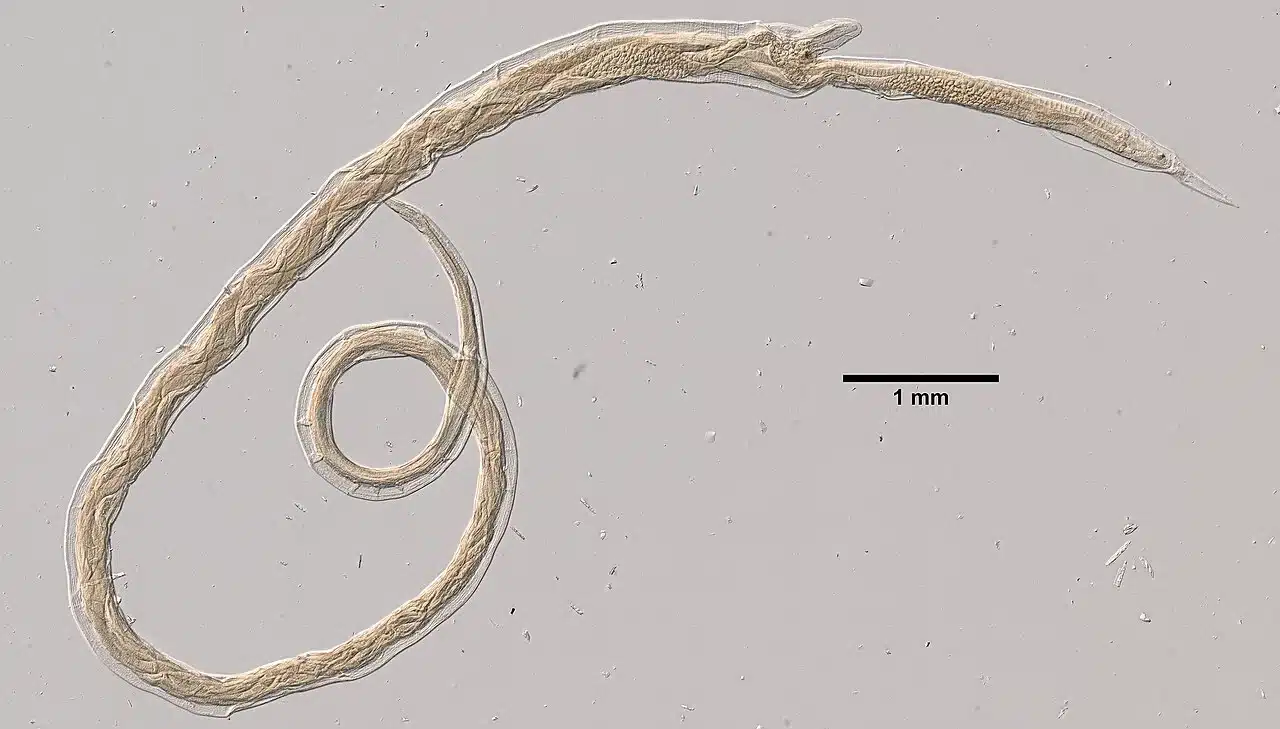
A barber pole worm is Haemonchus contortus, a roundworm that lives in the abomasum of goats and sheep and feeds on their blood. Adult worms are 10 to 30 mm long, according to the Merck Veterinary Manual. The female gets its name from the red, blood-filled gut twisting around its white egg-filled body, which looks like a barber’s pole.
It is small, but it does a lot of damage. Each worm takes about 0.05 mL of blood a day, and a single female can lay up to 10,000 eggs a day, as the Merck Veterinary Manual’s cattle parasite chapter notes for Haemonchus. A few thousand worms can drain more blood than a small goat can replace.
Barber Pole Worm Symptoms in Goats and Sheep
The main symptoms of barber pole worm are signs of blood loss: pale pink or white inner eyelids and gums, weakness, lagging behind the herd, and fluid swelling under the jaw (bottle jaw). Diarrhea is not a typical sign. If an animal has scours as well, another parasite is probably involved too.
The Merck Veterinary Manual describes three forms of the disease:
- Hyperacute: a very heavy infection can kill within a week, often before any sign is noticed.
- Acute: severe anemia with swelling (edema) under the jaw and along the belly.
- Chronic: a lower worm burden that causes ongoing anemia and steady weight loss.
Watch for these signs in goats and sheep:
- Pale or white inner eyelids (the FAMACHA check below)
- Pale gums and inside of the mouth
- Bottle jaw: a soft, fluid-filled swelling under the jaw. Read our full guide to bottle jaw in sheep and goats.
- Weakness, tiredness and lagging behind the herd
- Rough coat and weight loss despite good feed
- Lower milk yield in does and ewes
- Sudden death in a goat or lamb that looked normal the day before
Barber Pole Worm in Kids, Lambs and Pregnant Does Kids, lambs and does or ewes close to giving birth are the most at risk. Mothers lose part of their immunity for about 4 weeks before and 4 weeks after birth and shed more eggs then, according to University of Minnesota Extension. That rise in eggs lands on the same pasture where newborns start grazing. Check these groups more often. Our guide to how to tell if a sheep is pregnant covers the late-pregnancy weeks when the risk is highest.
How Do Goats and Sheep Get Barber Pole Worms? (Life Cycle)
Goats and sheep get barber pole worms by eating infective larvae on grass. The worm needs no other host: eggs pass out in manure, hatch on the pasture, and the larvae climb onto the forage that animals graze. Warm, moist weather speeds every step.
- Eggs are laid. Adult females in the abomasum lay thousands of eggs a day, which pass out in the manure.
- Larvae develop on the pasture. On grass, eggs become infective larvae in about 5 days, according to University of Minnesota Extension. Eggs on bare, dry dirt die quickly.
- Larvae wait on the forage. They survive up to about 2 months in warm weather and 6 months or more in cooler weather.
- Animals swallow larvae while grazing. The larvae move to the abomasum and mature.
- New adults start laying eggs. This happens 18 to 21 days after infection (the prepatent period), per the Merck Veterinary Manual.
Weather decides how fast this happens. The worm thrives between 50°F and 96°F and grows fastest between 86°F and 96°F. Below 50°F it goes dormant but can still survive on the pasture. That is why outbreaks peak in warm, wet months, and why a mild, rainy spell can trigger one.
How Do You Know If Your Goat Has Barber Pole Worms?
You know a goat may have barber pole worms when its inner eyelid is pale on a FAMACHA check, or when a fecal egg count shows a high number of strongyle-type eggs. FAMACHA is quick and costs almost nothing. The fecal test tells you how many eggs the animal is shedding. The most reliable approach uses both.
FAMACHA Score Chart: What Each Eyelid Colour Means
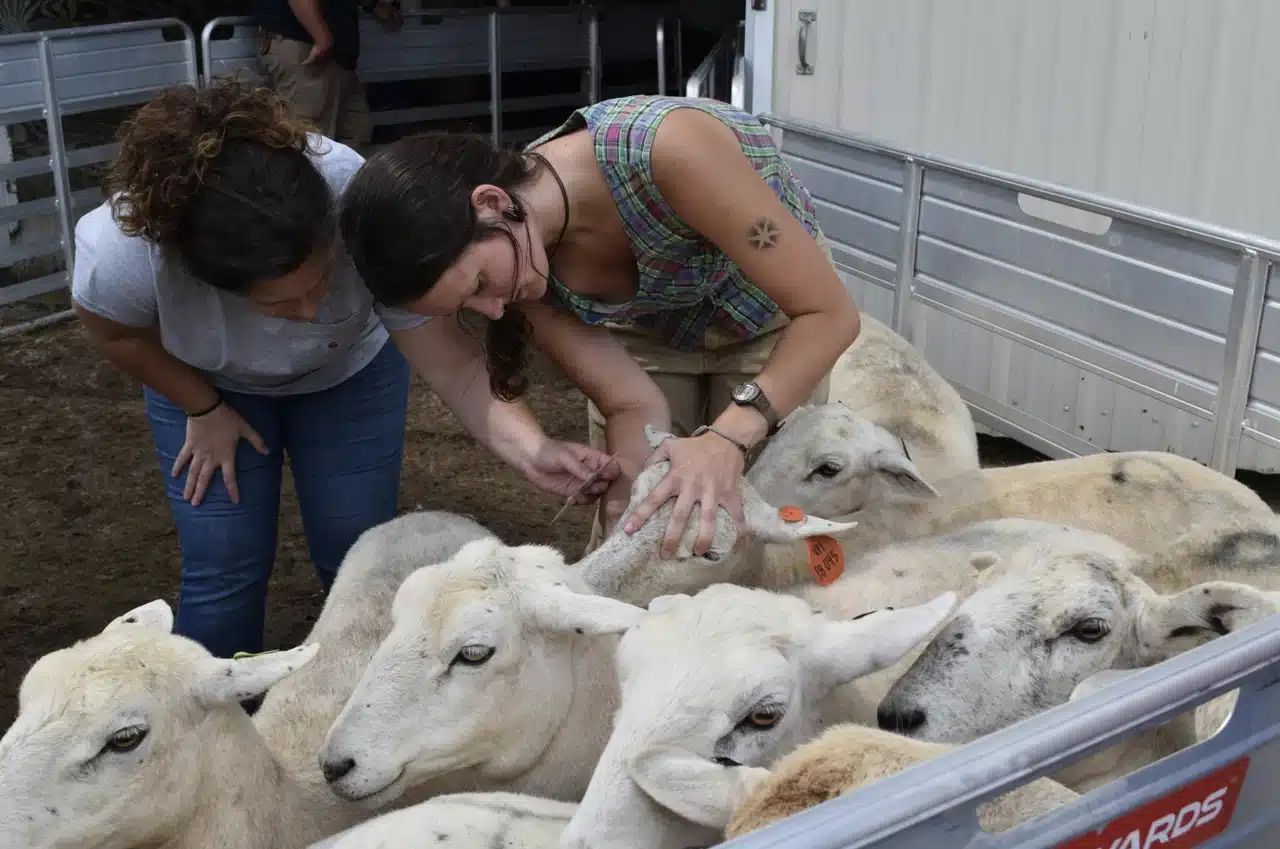
FAMACHA© is a five-colour card that you hold next to the inside of the lower eyelid to score anemia. Score 1 is healthy red, and score 5 is white and dangerously anemic. It only measures anemia, so it works for blood-feeding worms like the barber pole worm, not for other worms. The scores and treatment advice below come from the American Consortium for Small Ruminant Parasite Control (wormx.info).
| FAMACHA score | Eyelid colour | Anemia level | Deworm? |
|---|---|---|---|
| 1 | Red | None (PCV above 28%) | No |
| 2 | Pinkish-red | None to mild | No |
| 3 | Pink | Borderline | Maybe: decide with the Five Point Check |
| 4 | Pinkish-white | Anemic | Yes |
| 5 | White | Severe (PCV below 12%) | Yes, and call your vet |
PCV (packed cell volume) is the share of the blood made up of red blood cells. Score in natural daylight, check both eyes, and use the paler score if you are unsure. FAMACHA training is offered online by the University of Rhode Island, as listed in this SARE tipsheet. The card should come from an official source.
The Five Point Check
The Five Point Check© extends FAMACHA to other parasites by checking five places on the animal. It was developed by the same South African scientists who created FAMACHA, and it helps decide what to do with animals that score 3, as described in this wormx.info Five Point Check sheet.
| Point | What to check | What it can mean |
|---|---|---|
| 1. Eye | FAMACHA score | Anemia from blood-feeding worms |
| 2. Jaw | Swelling under the jaw | Bottle jaw from blood and protein loss |
| 3. Back | Body condition score (1–5) | Weight loss from a heavy worm load |
| 4. Tail | Dung on the tail and back legs | Scours from other worms or coccidia |
| 5. Nose | Nasal discharge | Nasal bots or other problems |
Each point can have other causes, so use it to decide which animals to look at more closely, not as a diagnosis on its own. University of Florida IFAS Extension suggests checking every animal every 2 to 4 weeks. The SARE FAMACHA tipsheet suggests weekly checks during heavy outbreaks when more than 10% of the flock scores 4 or 5.
Fecal Egg Count Test
A fecal egg count (FEC) measures how many worm eggs are in one gram of manure. It shows which animals are shedding the most eggs and, when repeated after treatment, whether a dewormer actually worked on your farm. Refrigerate samples but don’t freeze them, and get them tested within 48 hours, as University of Minnesota Extension advises. Barber pole worm eggs look like those of other strongyle worms, so a lab needs a special stain or a larval culture to confirm the species. Our guide to worms in goats covers the other worms these tests pick up.
Barber Pole Worm Treatment in Goats and Sheep
Barber pole worm is treated with a dewormer chosen with your vet, given only to the animals that need it (FAMACHA 4 or 5, or 3 with other warning signs), and then checked with a follow-up fecal egg count. Badly anemic animals also need supportive care from a vet.
The reason treatment is no longer simple is resistance. Barber pole worms have developed resistance to every available class of chemical dewormer, according to University of Minnesota Extension. The three main classes are benzimidazoles, macrocyclic lactones (the ivermectin group) and levamisole, as listed in the NCAT ATTRA FAMACHA tipsheet. A drug that works on one farm may fail on the next.
- Treat selectively, not on a calendar. Deworm the animals that need it and leave healthy ones untreated. The worms in untreated animals stay drug-sensitive (this is called refugia) and dilute the resistant ones.
- Use the right dose for goats. Goats break down many dewormers faster than sheep, so goat doses often differ from the label. Many products are used off-label in goats, so get the drug and dose from your vet.
- Check that it worked. Repeat the fecal egg count after treatment (a fecal egg count reduction test) to see whether the drug is still working on your farm.
- Respect withdrawal times for milk and meat on every product you use.
- Support recovery: good-quality feed, clean water, minerals, and moving the animal off contaminated pasture.
When to call your vet now: FAMACHA 5, an animal that can’t stand or won’t eat, sudden bottle jaw, or a death in the herd. Anemia this severe can kill quickly, and the stress of handling and drenching can be too much for a very weak animal without veterinary support.
Is There a Natural Treatment for Barber Pole Worm?
No natural remedy reliably cures an animal that already has a heavy barber pole worm load, so an anemic animal still needs a vet-chosen dewormer. Some feeds and products help prevent new infections:
- Tannin-rich forages such as sericea lespedeza slow egg hatching and reduce egg shedding, according to University of Minnesota Extension.
- Bioworma, a feed supplement fed through the grazing season, stops new larvae from developing in the manure. It does not treat existing worms.
- Breeding and culling: about 25% of a herd sheds roughly 80% of the eggs. Culling those high shedders and keeping resistant animals lowers the problem over time.
How to Get Rid of Barber Pole Worms in Pasture
You get rid of barber pole worms in pasture, and prevent new outbreaks, by keeping animals from grazing short grass, moving them to fresh pasture before larvae build up, resting pastures long enough for larvae to die, and treating only the animals that need it. The pasture figures below come from University of Minnesota Extension.
- Don’t let animals graze below 6 inches. Move them before the forage gets that short.
- Rotate fast in warm weather. Move to a new paddock every 5 days or less, before eggs dropped there become infective.
- Rest pastures for at least 2 months in summer before grazing them again.
- Mix species. Grazing cattle or horses with or after goats and sheep reduces the larvae left for small ruminants.
- Cut hay from infected pastures. Haying removes larvae, and the regrowth is cleaner.
- Don’t overstock. More animals per acre means more eggs on the same grass. Our sheep per acre calculator helps you set a safer stocking rate.
- Check new animals before they join the herd. Quarantine them, check FAMACHA, and run a fecal egg count.
- Keep records of every FAMACHA score, fecal test and treatment, so you can see which animals keep needing treatment.
Can Humans Get Barber Pole Worms from Goats?
Human infection with barber pole worm is very rare. Haemonchus contortus has been reported in people only occasionally, mostly in parts of Iran and Azerbaijan where people live in close contact with livestock, according to a 2020 report in BMC Infectious Diseases. Basic hygiene is enough for most farmers: wash your hands after handling manure and animals, and wash vegetables grown with manure.
Do Cows Get Barber Pole Worms?
Cattle can carry barber pole worms, but they are usually infected by a related species, Haemonchus placei. Haemonchus contortus is found in cattle only occasionally, according to the Merck Veterinary Manual. This is one reason grazing cattle with or after goats and sheep helps clean up a pasture.
Keep a Parasite Record for Every Animal
The farms that control barber pole worm best are the ones that write everything down. Record each animal’s FAMACHA score, body condition, fecal egg counts, treatments and their results. Over a season, the same few animals will keep needing treatment, and those are the ones to cull or not breed from. Animals Farming’s health management tools let you log scores and treatments for each goat or sheep, so these patterns are easy to see. For a wider view of flock health, see our guide to the 10 common diseases in goats and sheep.
This article is for education and does not replace a veterinarian. Dewormer choice, doses and withdrawal times must come from a vet who knows your animals and your region.