To start a dairy farm, you need dairy experience, a signed agreement with a milk buyer, a written business plan, a Grade A permit, a reliable feed supply, a milking setup that passes inspection, and enough cash to carry the herd until the first milk checks arrive. Most beginners in the United States start by renting an existing dairy and buying cows, because land and new buildings cost far more than the herd.
This guide is for beginners and families planning a commercial cow dairy that sells milk to a cooperative or processor. It walks through each step in the order you will meet it, with 2026 figures from USDA and university extension budgets. If you are raising beef cattle instead, see our guide on how to start a cattle farm.
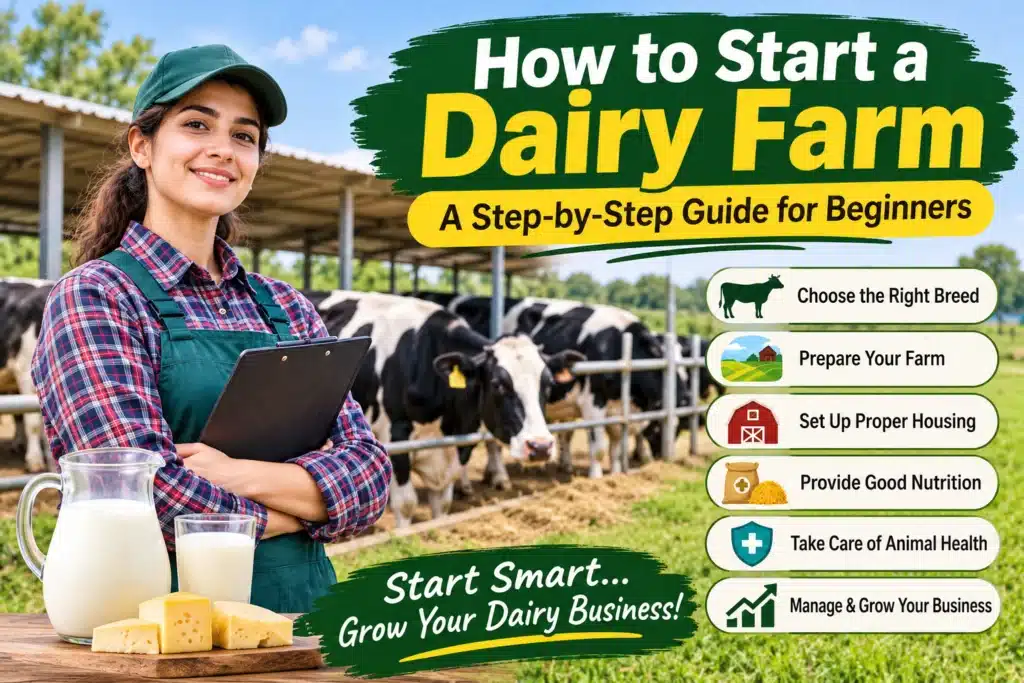
How to Start a Dairy Farm in 10 Steps
- Get hands-on experience: work on a commercial dairy before you invest (Step 1).
- Choose your dairy model: conventional, grazing, organic or on-farm processing, and whether to rent, buy or build (Step 2).
- Secure a milk buyer: sign with a cooperative or processor before you buy cows (Step 3).
- Write a dairy farm business plan: costs, milk income, break-even milk price and cash flow (Step 4).
- Plan feed and forage: grow it, buy it, or both (Step 5).
- Set up facilities: housing, milking parlor, milkhouse, bulk tank and manure storage (Step 6).
- Get your Grade A permit: pass the state inspection before the first pickup (Step 7).
- Buy healthy cows: pick a breed and buy tested animals (Step 8).
- Run daily dairy cow management: milking, feeding, health, breeding and records (Step 9).
- Protect your margin: enroll in Dairy Margin Coverage and line up financing (Step 10).
What Is Dairy Farming?
Dairy farming is the raising of cows (or goats, sheep or buffalo) to produce milk for sale. A dairy farmer manages a herd that is milked every day, feeds and breeds the cows so they keep producing, and sells the milk to a cooperative, a processor or direct to customers.
Is dairy farming commercial or subsistence? In the United States it is almost entirely commercial. Milk from a licensed farm is picked up by a bulk truck and sold under a Grade A permit. Subsistence dairying, where a family keeps one or two cows for its own milk, still exists in many developing countries but is rare in the U.S.
What is on a dairy farm?
- Milking cows and dry cows, the cows resting before their next calf
- Calves and heifers raised as future milking cows
- Housing: a freestall or tie-stall barn, or pasture with shelter
- A milking parlor and milkhouse with a refrigerated bulk tank
- Feed storage: silage bunkers or bags, hay, and commodity bins
- Manure storage and the equipment to spread it
Dairy husbandry is the day-to-day care that keeps that system running: milking, feeding, cow comfort, health, breeding and calf care.
Step 1: Get Hands-On Dairy Farming Experience
The first step to start a dairy business is to work on someone else’s dairy. Cows must be milked every day of the year, and the skills that decide profit (spotting a sick cow, reading heat, running a parlor, keeping milk quality high) are learned in the barn, not from a guide.
Ways to get dairy farming experience:
- Work as a milker or herd hand on a commercial dairy for at least a full year, so you see calving, breeding, winter and summer.
- Join a dairy apprenticeship. The registered Dairy Grazing Apprenticeship program pairs beginners with experienced graziers.
- Take short courses from your state’s land-grant university extension, such as herd health, milk quality and farm finance.
- Talk to the people you will rely on. Penn State Extension advises every new dairy to consult veterinarians, nutritionists, agronomists, lenders and extension educators, even if you grew up on a farm.
Before You Invest: Lenders, including the USDA Farm Service Agency (FSA), look for farm management experience when you apply for a loan. Documented time on a dairy strengthens your application.
Step 2: Choose Your Dairy Model and How You Will Get a Farm
Your dairy model decides your costs, your labor and who buys your milk, so choose it before you look at farms or cows.
| Dairy model | How cows are fed | Main trade-off |
|---|---|---|
| Conventional confinement | Mixed ration in a freestall barn year-round | Highest milk per cow; highest building and feed cost |
| Pasture-based grazing | Grazing most of the season, stored feed in winter | Lower feed and building cost; less milk per cow; needs good pasture |
| Organic | Certified organic pasture and feed | Higher milk price; certification, transition period and an organic buyer required |
| On-farm processing | Any of the above, milk bottled or made into cheese on the farm | Retail margin; adds a processing license, a plant and marketing work |
Penn State Extension’s point holds for every model: one size does not fit all, and several systems can be profitable when they match your goals, land and market. If you are still deciding between milk and beef, compare the two in our dairy cow vs beef cattle profitability guide.
Rent, Buy or Build?
- Rent an existing dairy and buy cows. Penn State Extension notes that many beginners buy cows first and rent the farm and land. The cows become your equity, and you avoid the largest capital cost.
- Buy an existing dairy farm. Buying a dairy farm that already holds a Grade A permit and a milk contract saves years of setup. Have the parlor, bulk tank, manure storage and water checked before you sign, and confirm the milk buyer will keep picking up.
- Build new. The most expensive route: the University of Missouri’s 2027 dairy planning budget puts a new 150-cow confinement dairy at about $1.49 million, or about $9,900 per cow, including cows. Few beginners start this way.
Step 3: Secure a Milk Buyer Before You Buy Cows
A dairy can only sell milk that a buyer has agreed to pick up, so find your market before you spend money on cows or equipment. In many regions, cooperatives and processors have limited room for new farms.
Your options:
- Dairy cooperative: you become a member-owner, and the co-op picks up, tests and markets your milk. Ask about membership fees, capital retains and any base or quota program that caps how much milk you can ship.
- Independent processor: a direct contract with a cheese plant or bottler. Ask how long the contract runs and how the price is set.
- Direct to customers: bottled milk, cheese or yogurt sold at the farm or farmers’ markets. This needs a processing license and plant on top of the farm permit.
Get these answers in writing before you go further:
- Will the buyer take your milk, from what date and in what volume?
- How is the price set (federal order class prices, components, quality premiums)?
- What hauling and marketing deductions come off your check?
- What quality standards and penalties apply?
Watch Out: A dairy with cows and no buyer has to dump its milk. Treat a written buyer commitment as the condition for every other step.
Step 4: Write a Dairy Farm Business Plan
A dairy farm business plan shows whether milk income will cover feed, labor, debt and your living costs, and it is what a lender reads before approving a loan. Penn State Extension calls it the first thing to do, along with a SWOT analysis of your strengths, weaknesses, opportunities and threats.
A milk production business plan covers:
- Herd size and dairy model, and your milk buyer from Step 3
- Startup costs: cows, equipment, facility rent or purchase, and working capital
- Annual operating budget per cow and for the herd
- Break-even milk price, the single most important number
- Monthly cash flow, including your family’s living costs
- Hiring plan and risk plan
Once the dairy is running, track income and costs against the plan every month; our farm accounting guide shows how to set that up.
What a Dairy Cow Earns and Costs per Year
The University of Missouri’s dairy planning budget (revised October 2026, for 2027) models a 150-cow confinement dairy that raises its own replacements. Its per-cow figures are a realistic starting point for your own budget.
| Per cow, per year | 22,000 lb of milk | 25,000 lb of milk |
|---|---|---|
| Milk sales at $21.25/cwt | $4,675 | $5,313 |
| Calf and cull cow sales | $1,055 | $1,055 |
| Total income | $5,730 | $6,368 |
| Feed | $2,818 | $3,002 |
| Labor (30 hours at $22.50) | $675 | $675 |
| All other operating costs | $1,471 | $1,532 |
| Total operating costs | $4,964 | $5,209 |
| Depreciation, interest, insurance, taxes | $845 | $845 |
| Total costs | $5,809 | $6,054 |
| Income over total costs | –$79 | $313 |
Two things stand out. Feed is about half of all costs (48.5% at 22,000 lb), so feed management drives profit. And milk per cow decides whether the dairy pays: the same farm loses $79 per cow at 22,000 lb and earns $313 at 25,000 lb. For context, USDA NASS puts the 2025 U.S. average at 24,390 lb of milk per cow.
Your Break-Even Milk Price
Break-even milk price per cwt = (Total costs per cow − Calf and cull income per cow) ÷ Milk sold per cow (cwt)
With Missouri’s figures, the break-even is about $21.61 per cwt at 22,000 lb and $20.00 per cwt at 25,000 lb. To cover operating costs only, it is about $17.77 and $16.61. Compare that with USDA’s October 2026 forecast of a $20.45 per cwt all-milk price for 2027: a 22,000-lb herd would cover its operating costs but lose about $255 per cow on total costs.
Startup Costs: Renting vs. Building
| Item | Rent a dairy, buy 100 cows | Build a new dairy (per Missouri budget) |
|---|---|---|
| Cows | About $313,000 at $3,130 per head | Included below |
| Barn, parlor, manure and feed storage | Rent (negotiate with the owner) | About $9,900 per cow in total |
| Working capital | Your first months of feed, labor and supplies until milk checks arrive | Same |
The $3,130 is USDA’s April 2026 national average for a replacement dairy cow. Prices vary by region and month, so get local quotes.
Step 5: Plan Your Feed and Forage
Feed is the largest cost on a dairy, close to half of total costs in Missouri’s budget, so decide early where it will come from. You can grow forage, buy it, or do both.
| Feed approach | Needs | Best fit |
|---|---|---|
| Grow most forage | Cropland, equipment and time for corn silage and hay | Farms with land and crop skills |
| Buy most feed | Storage and reliable suppliers; little land | Renters and small herds starting out |
| Custom hire or share equipment | A local custom operator or neighbor | Growing feed without buying a full line of machinery |
Penn State Extension makes four practical points:
- Pick a feeding system: a total mixed ration (TMR), grazing, or both.
- Work with a nutritionist on separate rations for milking cows, dry cows and heifers.
- Cut capital needs by custom hiring or sharing equipment when you grow your own feed.
- Consider double cropping: a small grain after corn silage works on many Pennsylvania farms.
Test every load of forage you buy or harvest. A forage test tells the nutritionist the protein and energy you are actually feeding. Our guide to hay bale types and weights shows how to check what you are paying for.
Step 6: Set Up the Barn, Milking Parlor and Manure Storage
A dairy needs five pieces of infrastructure before the first milking: cow housing, a milking system, a milkhouse with a bulk tank, feed storage and manure storage. In Missouri’s 2027 budget for a new 150-cow dairy, the milking parlor ($450,000) and the barn ($375,000) are the two biggest items.
| Facility | What it does | What to check on a rented or used dairy |
|---|---|---|
| Freestall or tie-stall barn | Houses the cows; drives cow comfort | Stall size, bedding, ventilation, heat abatement |
| Milking parlor | Where cows are milked | Capacity per hour, pulsation and vacuum service records |
| Milkhouse and bulk tank | Cools and holds milk for pickup | Cooling speed, wash system, size for every-other-day pickup |
| Feed storage | Silage, hay and commodities | Room for a year of forage, drainage, losses |
| Manure storage | Holds manure until it is spread | Capacity, condition, permits already in place |
The milkhouse and parlor must meet Grade A construction standards, so have your state milk inspector look at the plans or the existing setup before you sign a lease or start building.
Manure is a resource and a legal duty. Penn State Extension says every dairy needs a manure management plan, and larger farms may also need a nutrient management plan. Your county conservation district or extension office can tell you which applies to you.
Step 7: Get Your Grade A Permit, Licenses and Inspections
You cannot sell milk for drinking until a state inspector approves your farm and issues a Grade A permit. The standards come from the Grade A Pasteurized Milk Ordinance (PMO), which the U.S. Food and Drug Administration maintains and state regulators use.
What the PMO covers on a dairy farm:
- Construction: milkhouse floors and walls, ventilation, water supply and handwashing facilities
- Water source standards for the well or supply
- Milk quality testing: bacteria, somatic cell count, cooling temperature and drug residues, with set limits your inspector will explain
- Animal health and drug residue testing, with surveillance when a load tests positive
- Regular farm inspections to keep the permit
Other registrations to complete:
| Registration | Where to get it |
|---|---|
| Business structure (LLC, sole proprietor, partnership) | Your state’s Secretary of State |
| Employer Identification Number (EIN) | IRS, online |
| Premises identification number | Your state animal health office |
| Manure or nutrient management plan | County conservation district |
| Processing license (only if you bottle or make cheese) | State department of agriculture or health |
Before You Start: Call your state dairy inspector first. Inspectors can review plans before you build or rent, which is far cheaper than fixing a milkhouse after a failed inspection.
Step 8: Choose Dairy Breeds and Buy Healthy Cows
Choose the breed your milk buyer pays best for and your feed and facilities can support, then buy cows whose health and production records you can see.
| Breed | Strength | Consider when |
|---|---|---|
| Holstein | The most milk per cow; the most common U.S. dairy breed | You are paid mainly on volume and have high-quality feed |
| Jersey | Smaller cow with high butterfat and protein | Your buyer pays well for components, or you graze |
| Brown Swiss, Guernsey, Ayrshire | Hardy, good components | You want a niche or a specific milk for cheese |
| Crossbreds | Hybrid vigor: often better fertility and longevity | You value fewer health and breeding problems over peak milk |
 AI-generated
How to Buy Healthy Cows
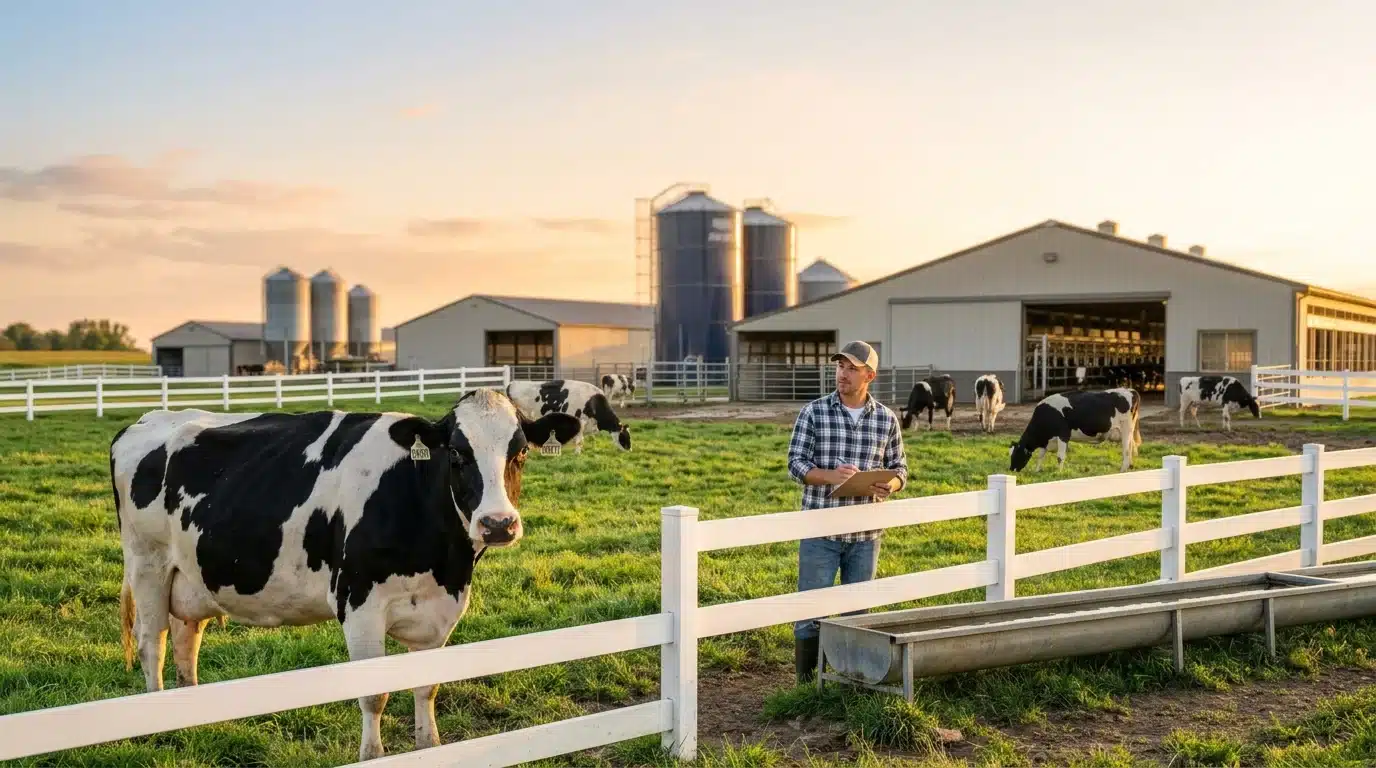
- Buy from one or a few known herds, not from many sources. Each new herd brings new disease risk.
- Ask for records: milk production, somatic cell counts, breeding dates, vaccinations and treatments. Herds on a DHIA milk-testing program have them.
- Have your veterinarian examine cows before purchase and test them for the diseases common in your region, such as Johne’s disease.
- Isolate new animals on arrival, for as long as your veterinarian advises, before they join the herd.
USDA’s April 2026 national average for a replacement dairy cow was $3,130 per head, a record at the time, so herd purchase is a major cost. Estimate the purchase and yearly ownership cost of your herd with our cattle purchase and ownership cost calculator. Many dairies later raise their own replacements from their best cows.
Step 9: Run Daily Dairy Cow Management
Dairy farm management is a biological system, as Penn State Extension puts it: profit depends on healthy cows, steady milk and calves that become the next generation. Five routines run every day.
Milking
Milk on a fixed schedule, every day. Follow the same routine for every cow: check foremilk, clean and dry teats, attach units, and dip teats after milking. A steady routine keeps milk quality high and mastitis low.
Feeding
Feed separate rations to milking cows, dry cows and heifers, as your nutritionist sets them. Push feed up so cows can eat at all times, and give unlimited clean water.
Herd Health
Work with your veterinarian on a written herd health plan: vaccinations, regular herd checks, hoof care and a plan for the transition period around calving, when most health problems start. Log every treatment so withdrawal times are never missed; our health and treatment tracking guide shows how.
Breeding and Calf Care
A cow only milks after she calves, so every month a cow stays open costs money. Use artificial insemination or a bull, track heats and pregnancy checks, and give every newborn calf colostrum quickly. Our breeding and calving guide covers how to keep those dates in one place.
Records
Track milk per cow, somatic cell count, breeding, treatments and feed costs. Records show which cows pay and back up your loan renewals. Keep them together in livestock record keeping software.
Labor
Missouri’s budget allows 30 hours of labor per cow per year. For 100 cows that is about 3,000 hours, more than one full-time person, every day of the year. Plan who milks when you are sick or away before the first cow arrives, and set out shifts and tasks with an employee and task management plan. Penn State’s advice: be the manager first, and hire or contract out the jobs that are not your strength.
Step 10: Protect Your Margin and Finance the Dairy
Milk prices and feed costs swing, so a new dairy needs price protection and financing that fits its cash flow.
Dairy Margin Coverage (DMC)
Dairy Margin Coverage is a USDA Farm Service Agency program that pays when the national margin between the milk price and a feed cost falls below the level you choose. For 2027:
- Coverage levels run from $4.00 to $9.50 per cwt of margin.
- Tier 1 covers up to 6 million pounds of production, up from 5 million.
- The catastrophic level has no premium, only an annual $100 administrative fee.
- Enrollment for 2027 runs October 5 to December 18, 2026, at your county FSA office.
- DMC is authorized through 2031.
Financing Options
| Source | Typical use | Key limit |
|---|---|---|
| FSA Operating Microloan | Cows, feed, small equipment | Up to $50,000 |
| FSA Direct Operating Loan | Larger herd and equipment purchases | Up to $400,000 |
| FSA Guaranteed loans (through your bank) | Larger operating and ownership needs | $2,343,000 combined for fiscal year 2026 |
| Farm Credit or a local ag lender | Cows, equipment, land | Collateral, credit history and a written plan |
FSA microloans let beginners with limited experience qualify with a mentor, and the FSA loan limits for fiscal year 2026 set the caps above. Penn State Extension’s advice on equity applies here: buy cows first, rent facilities, and build equity before taking on land and building debt.
Dairy Farming Facts: The U.S. Industry in 2025–2026
U.S. dairy produces more milk every year from fewer, larger farms. A new dairy enters a market where scale and milk per cow decide who stays.
| Measure | Figure | Source |
|---|---|---|
| Licensed dairy herds, 2025 | 23,609, down 1,036 (4.2%) from 2024 | USDA NASS |
| Milk cows, 2025 average | 9.50 million head | USDA NASS |
| Milk per cow, 2025 | 24,390 lb | USDA NASS |
| Total milk production, 2025 | 231.7 billion lb | USDA NASS |
| Milk production forecast, 2026 | 236.9 billion lb | USDA WASDE, October 2026 |
| All-milk price forecast | $19.90/cwt for 2026; $20.45/cwt for 2027 | USDA WASDE, October 2026 |
Dairy farming is practiced in every U.S. state and around the world. In the United States it is a commercial business regulated under the Grade A program.
Sources
- Penn State Extension – 8 Things You Need to Know Before Starting Your Own Dairy Farm (updated Dec. 2025)
- University of Missouri Extension – Dairy (Confinement) Planning Budget (G676), revised October 2026
- USDA NASS – Milk Production report, February 20, 2026 (2025 annual figures)
- Progressive Dairy – USDA October 2026 WASDE milk production and price forecast
- Progressive Dairy – Replacement dairy cow prices hit new record high (USDA, April 2026)
- USDA FSA – 2027 Dairy Margin Coverage enrollment (Sept. 30, 2026)
- Penn State Extension – The Grade A Pasteurized Milk Ordinance
- USDA FSA – Microloan Programs
- USDA FSA – Farm loan limits, fiscal year 2026 (1-FLP)
