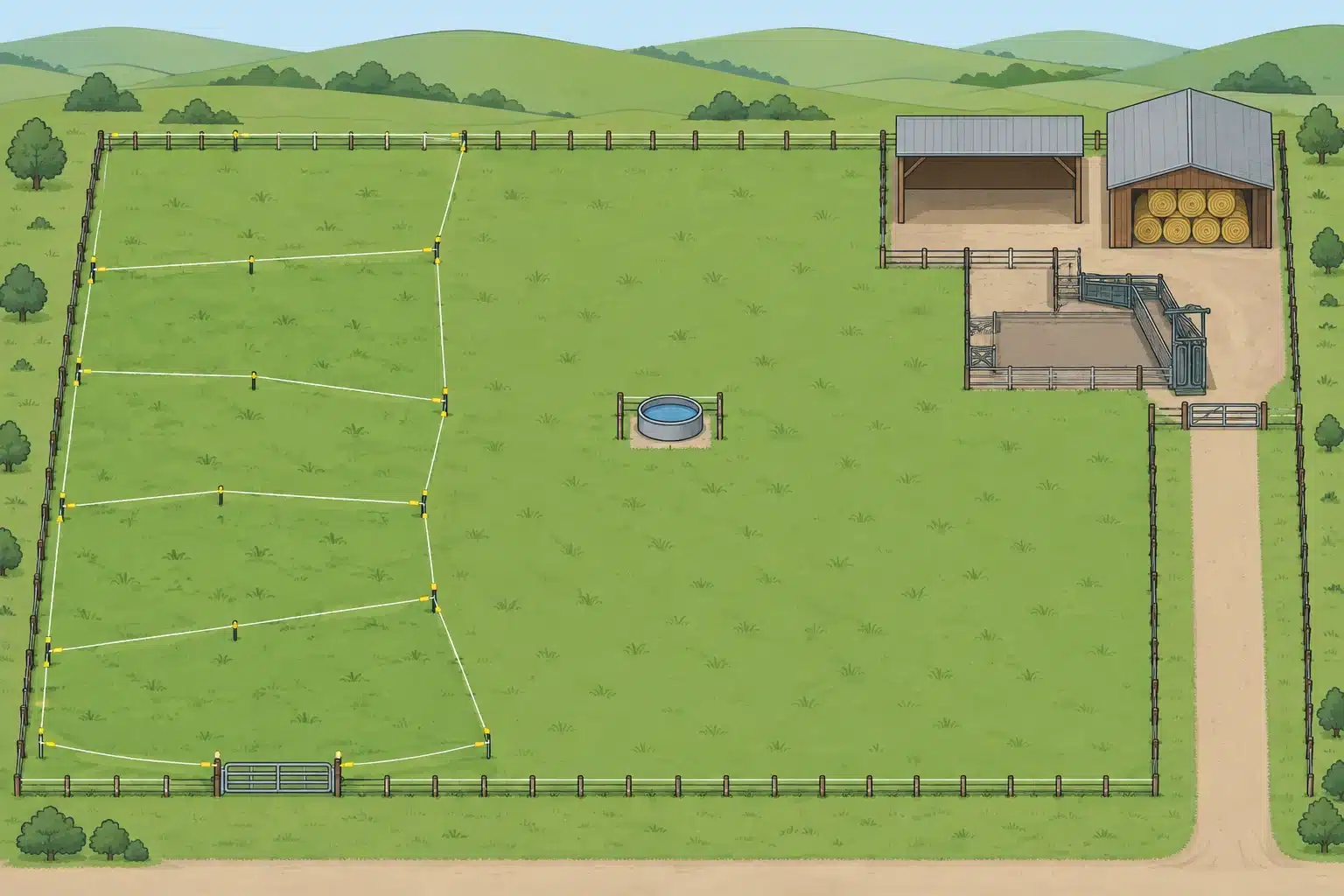
Starting a cattle farm means choosing between three main types of operation: cow-calf, stocker, or small-farm beef production. Then you buy healthy animals, build fencing and water systems, and manage daily feed and herd health. Success requires a realistic business plan, a financial buffer for lean years, and commitment to record-keeping from the first animal you buy.
Is Starting a Cattle Farm Right for You?
Cattle farming requires year-round work, a financial buffer to weather lean years, and patience while animals grow to market weight or breeding maturity. Deciding whether beef cattle fit your time and capital comes before you buy a single animal.
The Daily and Seasonal Work
Cattle need water and feed every day, seven days a week, regardless of weather or your schedule. In winter, you haul hay and break ice. In spring, you check calving cows for complications.
Year-round, you move animals to fresh pasture, mend fence, treat illness, and handle paperwork.
A small herd of 20 to 50 cattle takes 1 to 2 hours daily for basic care. Add more time for larger tasks like vaccinating, treating sick animals, or moving to new pasture. If you work off-farm or cannot be present most days, cattle farming becomes harder and more risky.
Calving season (typically late winter and early spring) demands extra vigilance. Cows may calve at night, and a calf in trouble can die within hours if you do not notice. You need to recognize normal birth, spot a breached presentation, and know when to call the veterinarian.
Capital and Financial Patience
Beef cattle take time to return money. A calf born in spring does not reach market weight until late fall or the following year. You feed and care for it for 12 to 18 months before selling.
Breeding cows do not produce income until their calves are weaned and sold, typically 8 to 12 months after birth.
You need enough cash on hand to buy animals, feed them through a winter with no sales, and cover emergencies such as a sick animal, a fence repair, or a veterinary visit.
Market and Profit Uncertainty
Cattle prices change month to month based on supply, feed costs, and demand. You cannot control these, but you can time your sales and control your feed costs to stay profitable.
A lean year (drought that reduces pasture, high feed prices, or a low market price when you sell) can wipe out profit from the previous year. Experienced operators budget for this; new ones are often surprised.
Skills You Will Need to Learn
You need to recognize a healthy animal at purchase. Spot illness or injury early. Handle cattle safely without injury to yourself or the animal.
Keep records that show whether you are making money or losing it.
These skills take hands-on practice. A relationship with a veterinarian and your local extension office is not optional; it is your fastest route to learning what works on your place.
If you can commit to daily care regardless of weather, have capital to sustain the operation through the first 18 months before sales revenue arrives, and are willing to learn the business side alongside the animal side, cattle farming can be profitable. If any of these points feels uncertain, spend more time planning and less time buying animals.
Types of Cattle Operations
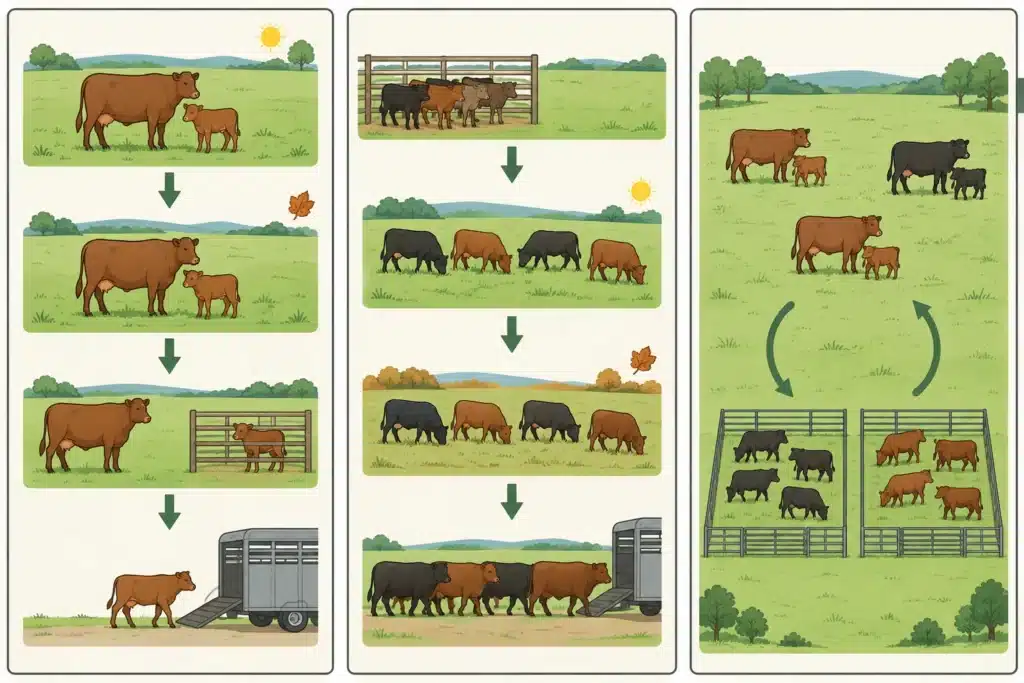
Beef cattle operations fall into three main types, each with different income patterns, animal types, and labor needs. Your choice determines when you sell, what cattle you buy, how much pasture and feed you need, and whether you turn a profit.
 AI-generated
Cow-Calf Operations
A cow-calf operation keeps breeding females (cows) on pasture year-round and sells their calves after weaning, typically in fall or spring. You buy or breed cows and let them raise calves on pasture through the grazing season. Then you wean the calves and sell them at 4 to 8 months old, usually weighing 400 to 700 pounds.
Income arrives twice a year (spring and fall sales) but only after calves are born, grow, and reach market weight. This operation requires fewer total cattle than stocker or finishing operations. It demands year-round pasture management and careful breeding timing so calves are born when spring grass is growing.
Weaning is the process of separating calves from their mothers and stopping them from nursing, usually when calves are 4 to 8 months old.
Cow-calf is the slowest operation to build profit but requires the least infrastructure and grain feeding. Your main costs are pasture maintenance, hay for winter, veterinary care for breeding cows, and supplements for young calves.
Stocker Operations
A stocker operation (also called backgrounding) buys young cattle that have been weaned. It feeds them to heavier weight on pasture or in pens, then sells them when they reach target weight. You purchase cattle at 400 to 600 pounds, feed them for 6 to 12 months until they weigh 900 to 1,200 pounds, then sell them to a finishing operation or directly to a processor.
Stocker operations generate income faster than cow-calf (in months rather than years) and require no breeding infrastructure or calving facilities. However, they need reliable access to good pasture or the capital to buy hay and grain. Input costs are higher because every pound of gain must be purchased as feed; you do not have the low-cost weight gain that a cow’s milk provides to her calf.
Stocker is a good entry point if you have pasture but no experience breeding or calving cattle. It also lets you test your infrastructure and animal-handling skills before committing to breeding females.
Small Farm or Homestead Beef Cattle
Small farms often run a mix: a few cows that raise calves, plus purchased young cattle for backgrounding or finishing on surplus pasture and grain. Some small producers also sell direct to consumers or local processors, marketing grass-fed or pasture-raised beef at retail prices rather than auction-barn wholesale prices.
Direct sales require food-safety permits, a licensed processor, customer relationships, and more labor on marketing and delivery. They can be more profitable per pound than wholesale auction sales, but they demand extra time and marketing skill beyond animal husbandry.
Small mixed operations fit farms with limited capital and good pasture but are labor-intensive because you manage multiple production stages at once. Start small, establish a routine, and grow as your skills and infrastructure allow.
Choosing Your Operation Type
| Operation Type | Cattle You Buy | Time to First Sale | Main Skill Needed |
|---|---|---|---|
| Cow-calf | Breeding cows and bulls | 9 to 12 months | Breeding and calving management |
| Stocker | Young weaned cattle | 6 to 12 months | Pasture and feed management |
| Small farm mixed | Cows, young cattle, or both | Varies (3 to 12 months) | Flexibility and diverse skills |
Choose the operation type that matches your pasture quality, available capital, and market access. Cow-calf operations need less grain but require good calving outcomes. Stocker operations need good pasture or grain budget but no breeding infrastructure.
Small mixed farms need the skill to manage multiple stages at once.
Managing Pasture and Feed across Operation Types
Every operation depends on pasture quality and availability. Poor pasture forces expensive supplemental feeding and poor animal performance. Rotational grazing improves forage quality, reduces parasite burden, and lowers feed costs compared to grazing the same area continuously.
Winter feed costs are the single largest budget item for every operation. Estimate hay and grain needs before you buy animals, and confirm your storage capacity and budget before winter arrives.
Best Cattle Breeds for Beginners
Angus, Hereford, Simmental, Charolais, and Limousin are the most practical beef breeds for a small farm or a beginning cattle operation. Each breed differs in how efficiently it converts feed to weight gain, how fast calves grow, and how well it tolerates heat or cold. Your choice depends on your pasture quality, your region’s climate, and what buyers in your market prefer.
Why Breed Matters for Your Operation
A breed’s genetics affect feed costs and how fast cattle reach market weight. Some breeds are leaner and more efficient on pasture; others gain weight faster on grain but may cost more to finish. British breeds (Angus and Hereford) are smaller-framed.
They reach market weight on grass alone and are easier to handle. Continental breeds (Simmental, Charolais, Limousin) are larger and grow faster. They produce heavier carcasses but need better pasture or supplemental feed.
Heat and cold tolerance also differ. Angus and Hereford are hardy in cold climates and handle humidity well. Charolais and Simmental struggle in extreme heat.
Limousin is moderate in both. Before you buy, ask your regional extension office or a local cattleman which breeds do best in your climate.
Cattle Breeds Suited to Small Farms
| Breed | Frame Size | Key Traits | Best For |
|---|---|---|---|
| Angus | Small to medium | Docile, efficient, marbled meat | Grass-fed, cold climates |
| Hereford | Medium | Tough, low input, good mothers | Pasture-based, lean forage |
| Simmental | Large | Fast growth, versatile, lean | Good pasture, shorter season |
| Charolais | Large | Rapid weight gain, large muscle | Finishing systems, feed-lots |
| Limousin | Medium to large | Lean, hardy, efficient converters | Mixed systems, moderate climates |
Choosing a Breed for Your Situation
Angus cattle are the most common choice for small farms and beginners. They are calmer than some breeds, finish well on pasture alone, and produce beef with good marbling (fat within the muscle) that commands a premium price. Angus cows are good mothers and maintain condition on moderate forage.
If you are running a cow-calf operation and selling calves through a conventional market, Angus or Angus-cross calves are easy to sell.
Hereford cattle are hardy, adaptable, and thrive on poor-quality pasture or sparse forage. They are excellent mothers and live longer productive lives than some other breeds. Herefords are heavier-framed than Angus and take longer to finish, so they are better suited to stocker operations or farms with extended grazing seasons.
They are popular in western ranching and are a solid choice if your pasture is marginal.
Simmental cattle grow fast and are versatile: some lines are beef animals, others are dual-purpose (meat and milk). They do well in stocker operations because they gain weight quickly on good pasture. Simmantals need better forage quality than Herefords and do not do as well on sparse grazing.
Choose them if you have adequate pasture and want cattle that finish in less time.
Charolais cattle are large and convert feed to muscle very efficiently, making them popular for finishing cattle on grain. They are less suited to small farms on pasture alone because they need high-quality feed and can be flighty (nervous and hard to handle).
If you are buying feeder cattle to finish and sell, Charolais-cross calves grow well; if you are running a pasture-based cow-calf operation, they are not the best fit for a beginner.
Limousin cattle are a middle ground: they are leaner than Angus, less demanding than Charolais, and efficient on moderate pasture. They are smaller-framed, which means lower birth weight and fewer calving problems. Limousins are a good choice if you want fast-growing calves without the size and feed demands of continental breeds.
Market Preference and Selling Options
Before you commit to a breed, find out what your local market pays for. Call sale barns or meat processors in your region and ask which breeds and crosses bring the best price per pound. Angus and Angus-cross cattle are marketed heavily and often earn a premium at conventional sales.
Purebred Herefords have a loyal niche market. Continental breeds (Simmental, Charolais, Limousin) are common in stocker and finishing operations but may not command as much as Angus in a small local market.
If you plan to sell direct to consumers or through a processor, breed matters less: focus on quality and consistency instead. If you are selling through a livestock auction, choose a breed that moves easily at your nearest sale barn.
Startup Costs and Budget Estimates
Starting a small beef cattle farm requires capital for infrastructure, animals, and first-year operating costs. A realistic budget helps you decide whether to begin now or wait, and shows you where to spend first to keep animals safe and healthy.
Startup costs divide into five categories: land improvements and fencing, water and handling facilities, the animals themselves, feed for the first year, and veterinary care and supplies.
Fencing and Pasture Preparation
Perimeter fencing is your first major investment and the most visible cost. Beef cattle need sturdy perimeter fencing, usually 5 to 6 wires of high-tensile electric fence or 4-strand barbed wire, to hold them safely and prevent escape or theft.
For a small starting herd, you will need perimeter fencing around your grazing area. Ask your local extension office or a fencing contractor for the current cost per linear foot in your area; prices vary widely by region, terrain, and whether you install it yourself or hire help.
Pasture preparation, clearing brush, filling holes, removing debris, may add cost if the land is rough. If you plan rotational grazing (moving cattle to fresh pasture to let grazed areas recover), you will also need interior cross-fences, which cost less than perimeter fencing but extend your total.
Water and Handling Infrastructure
Beef cattle need fresh water daily, year-round. A water system requires installation of a well and pump, piped troughs in pastures, or tank systems. Estimate cost by asking a well contractor or farm supply dealer what a basic system costs in your area.
Handling facilities, a corral, squeeze chute, and loading chute, are essential for working cattle safely during vaccinations, treatment, breeding, and loading for sale. A simple corral for a small herd can be built from pipe or wood; a used or basic squeeze chute can be purchased new or second-hand. Budget time and money here; poor handling facilities make every job harder and put you and the cattle at risk.
Shelter and Storage
Beef cattle need shelter from extreme weather: wind, heavy snow, or intense heat. A three-sided shelter open to pasture, or access to tree cover and a dry area, is usually enough. If you are in a cold climate, ensure there is a dry place for cattle to bed down in winter.
You will also need dry storage for hay, grain, and feed supplements. A simple shed or covered area keeps feed from spoiling and prevents waste from weather.
The Animals: Breeding or Growing Cattle
The cost of cattle themselves depends on what you buy and what you plan to do with them.
| Animal Type | Typical Use | Budget Range | Profit Pattern |
|---|---|---|---|
| Bred cows (age 3 to 8) | Cow-calf operation: produce calves annually | Per local sales; ask your sale barn | Calf sales in fall or spring; slow to break even |
| Young stock (age 6 to 12 mo) | Stocker or backgrounding: feed to heavier weight | Per lb. of body weight; ask your sale barn or video auction | Income when sold at target weight; 6 to 12 months |
| Feeder calves (age 4 to 8 mo) | Small farm: grow to finish or resell | Per lb. of body weight; ask your sale barn | Flexible: sell lighter or finish on-farm |
Bred cows (breeding females) are the most expensive upfront but produce calves year after year. Young stock and feeder calves cost less per head but require more feed per pound of live weight as they grow. Check your nearest sale barn for current prices in your area.
Feed and Nutrition for Year One
Hay is often your largest feed expense. Estimate how many tons of hay you will need and ask local hay producers or a feed dealer for current prices delivered to your farm.
Grain, mineral supplements, and salt cost extra but are necessary to keep cattle healthy and growing. Talk to a veterinarian or extension nutritionist to estimate your feed costs once you know the number and type of cattle you plan to keep.
Veterinary Care and Supplies
Vaccination, parasite prevention, and treatment supplies are ongoing costs. Budget for an initial veterinary visit before cattle arrive to discuss a health plan and inspect your facilities, and for regular visits or phone consultations during the year.
Medications, vaccines, and supplies vary by region and herd size. Ask your veterinarian for an estimate of routine health care costs based on your herd size and plan.
A Realistic Small-Farm Budget
For a first small herd, expect infrastructure and startup to dominate early costs. Ask local contractors and suppliers for quotes on perimeter fencing, basic water and handling facilities, and shelter and storage.
The cost of young growing cattle or bred cows depends on the market and what you buy; ask your sale barn or a livestock broker. First-year hay and feed costs depend on pasture quality and season length; ask your hay supplier and feed dealer for estimates. Veterinary care, minerals, and supplies also need budgeting; ask your veterinarian.
Buying Your First Healthy Cattle
Buying healthy cattle means choosing animals with good body condition, clear eyes, sound feet, and no signs of illness or lameness. Ask the seller about health history, vaccination records, and any treatments the animal has had, and know the difference between breeding stock, growing cattle, and market-ready animals so you buy the right type for your operation.
What a Healthy Animal Looks and Acts Like
A healthy beef calf or young steer stands alert with bright, clear eyes. There should be no discharge from the nose or eyes. Run your hand along the ribs and backbone.
You should feel bone under a light layer of muscle and fat, not sharp ribs or a hollow flank. This balance is called body condition score, a visual assessment of how much fat or muscle a cow is carrying on a scale of 1 (very thin) to 9 (very fat), used to decide whether the animal is eating enough.
Check the feet and legs closely. Hooves should be intact and level, and the animal should walk without limping or favoring a leg. Watch how the animal moves in the pen or pasture: a healthy steer moves freely without stiffness or reluctance.
Ask the seller to move the animal so you can see it walk.
Watch for signs of illness: coughing, labored breathing, or a hunched posture means respiratory disease. Diarrhea or loose manure can signal digestive upset or parasites. A swollen jaw or neck, called bottle jaw, is a soft swelling under the lower jaw that signals a serious parasitic or nutritional problem.
Do not buy an animal with these signs.
Questions to Ask before You Buy
- Vaccination history: Ask which vaccines the animal has had and when. Ask your veterinarian which vaccines are standard in your area before arrival.
- Parasite control: Has the animal been treated for internal parasites (worms) and external parasites (lice, mange)? When was the last treatment?
- Source and previous owners: Where did the animal come from? Cattle from auction barns carry more disease risk than those from a known herd. Ask why the seller is selling.
- Feed and water access: What has the animal been eating? A sudden change in feed causes digestive upset and weight loss. Plan to transition the new animal gradually to your feed over a week or more.
- Breeding history (for breeding stock): If buying a cow or bull, ask about previous calves, any breeding problems, and whether the animal is proven (has calved successfully before).
Types of Cattle to Buy and How They Differ
| Type | Age / Weight | What You Pay For | Best For |
|---|---|---|---|
| Breeding cow | 2 to 10 years old | Proven ability to calve and milk | Cow-calf operations |
| Bull | 1 to 8 years old | Genetics and fertility | Breeding multiple cows |
| Weaned calf | 4 to 8 months old | Weight gain potential | Stocker or backgrounding |
| Growing steer | 10 to 18 months old | Frame and muscle | Finishing to market weight |
| Finished steer | 18 to 24 months old | Meat quality, ready to sell | Direct sale or processor |
A breeding cow is a long-term investment. She should be healthy, structurally sound (good feet, legs, and udder), and of proven fertility. A weaned calf is lighter in weight and costs less upfront but requires more feeding and care to reach market weight.
A growing steer or heifer is part way to market and needs less time, but you pay more per pound. A finished steer is ready to sell but offers you no margin if prices drop.
Where to Buy Cattle
From a known breeder or farm: You can visit, observe the herd’s health and handling, and ask detailed questions. The seller has a reputation to protect. Expect higher prices but better health history and genetics.
From an auction barn or sale: Large numbers of cattle are offered; prices are often lower because you buy quickly and have less time to inspect. Health risk is higher because animals from many sources are mixed together. Bring a veterinarian if you can, or bid on cattle you have seen in person and handled.
Online or through a broker: Cattle are listed with photos and description. You cannot inspect the animal before buying. Use this method only if you know the seller or broker well, or if a vet can inspect on your behalf before transport.
Health Treatments and Records before You Buy
Ask for written health records from the seller: vaccination dates, medicines given, and results of any testing. If the cattle came from a herd tested for diseases like tuberculosis or brucellosis, ask for proof.
A withdrawal period is the time after a treatment with a medicine or vaccine before the animal’s meat or milk can be sold for human consumption. If you plan to sell meat, ask about any antibiotics or other medicines the animal has had and when they were given.
Check the product label or ask your vet for the withdrawal period; if the animal was treated recently, you may have to wait weeks before you can sell it.
Keep all health records you receive from the seller. Add them to your own records as soon as the animal arrives, so you have a complete history.
Essential Infrastructure and Facilities
Infrastructure, fencing, water systems, handling facilities, and shelter, must be built or repaired before cattle arrive. Without them, you cannot safely hold animals, observe them daily, or treat injury or illness when it happens.
 AI-generated
Fencing and Handling Systems
Perimeter fencing keeps cattle in your pasture and prevents them straying onto roads or neighboring land. Beef cattle need sturdy fencing; electric fencing works for rotational grazing, but perimeter fencing should be wire, board, or combination fencing so cattle cannot escape during a storm or if power fails.
Check your perimeter fencing before you buy cattle. Walk the entire boundary and look for gaps, downed wire, broken posts, and places where cattle could push through or under. Repair or replace any section that is not solid; a gap costs less to fix now than to chase escaped cattle later.
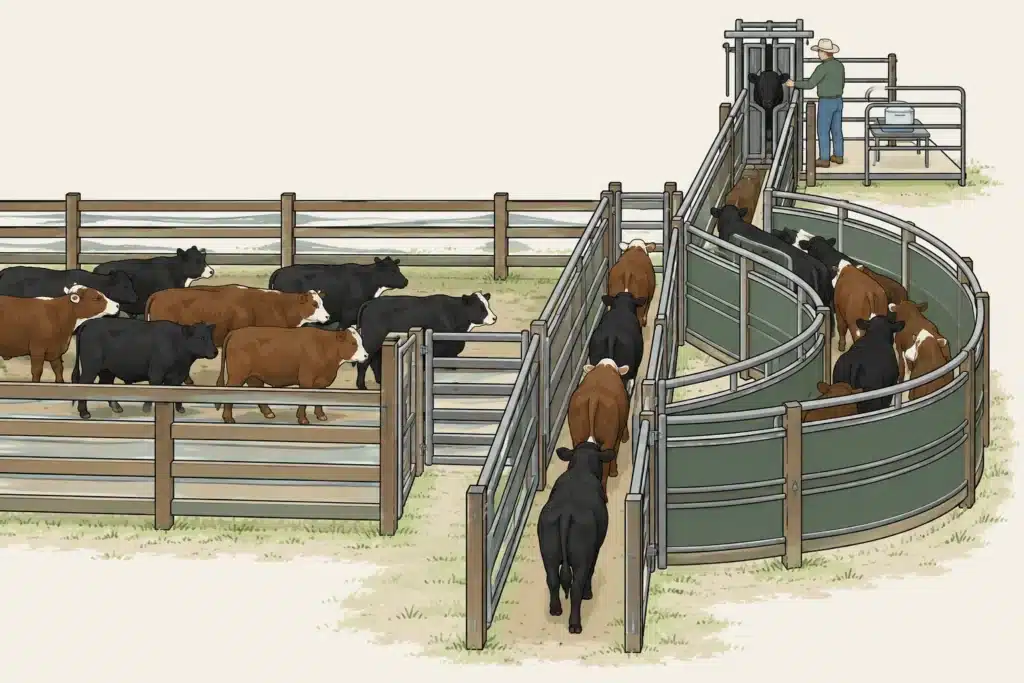
Working facilities, a corral or pen where you can safely handle cattle for vaccination, treatment, or loading, are separate from pasture fencing. A basic system includes a catch pen (a smaller pen where cattle can be held), a chute (a narrow lane that allows one animal through at a time), and a squeeze chute or headgate (equipment that holds the animal’s head still for an injection or examination).
You can buy ready-made chutes or build a simple system with panels and posts. The system does not have to be large; a small one handles three to five cattle at a time, which is enough for a beginner operation.
Water Supply
Cattle need fresh water every day, in every season. Water use varies with temperature, season, and the moisture content of forage.
Your water source can be a well, a spring, a natural pond, or trucked-in water, but it must be reliable. Water from a natural pond can carry parasites and disease; if that is your only source, have it tested before you rely on it.
efore animals arrive. Options include:
- Automatic waterers: Attached to a water line, these freeze in winter in cold climates and need insulation or heat tape to work year-round. They are efficient but require electricity or a water line to the pasture.
- Tanks filled by hose: A 50- to 100-gallon tank per 5 to 10 cattle is common. You fill it daily, or more often in hot weather. This works for small herds and does not require permanent infrastructure, but it is daily labor.
- Tanks filled by spring or gravity flow: If your water source is uphill, a gravity-fed line can fill a tank without power. This saves labor but requires trenching and uphill terrain.
If you use tanks, place them where cattle cannot muddy them or spoil the water with manure. Move them between pastures when you move cattle to rotational grazing areas, or place one in each pasture.
Shelter and Shade
Beef cattle do not need a fully enclosed barn for most of the year. They are hardy animals with thick hides designed for outdoor life. However, they benefit from shelter during extreme weather: heavy rain, deep snow, or heat above 85 degrees Fahrenheit.
Shelter can be a three-sided roof structure, called a run-in shed. It allows cattle to stand out of wind and rain while remaining open so they can move in and out freely. Size it at about 30 to 50 square feet per animal so cattle do not crowd or injure each other.
In very cold climates, calves and thinner animals may need more enclosed shelter in winter; consult your veterinarian about requirements in your region.
Shade in pasture can be trees, a portable shade structure, or a run-in shed. On hot days, cattle gather in shade and stop grazing. This reduces weight gain.
Trees are free if they are already in your pasture; if you need to add shade, one shade structure serving a group of cattle is cheaper than individual ones.
In winter, provide stored hay or shelter that allows cattle to stay dry and out of the harshest wind. Wet cattle in freezing temperatures can develop frostbite on ears and teats; good drainage and shelter prevent this.
Feeding and Nutrition
Beef cattle eat pasture in the growing season and stored hay or grain in winter; the cost and quality of feed depend on your pasture, your climate, and whether you sell cattle at lighter weight or finish them to market-ready condition. Finishing is the final stage of raising beef cattle, when they are fed grain and hay to add fat and reach market-ready weight and quality.
A feed plan that matches your cattle’s age, season, and target market weight keeps costs down and animals healthy.
Pasture is the cheapest feed source if your land grows good forage, but quality varies by region and year. Spring and early summer pasture is rich in nutrients; late summer forage may be thinner. Rotational grazing, moving cattle to a fresh pasture before they graze all the forage in one area, allows the grazed area to recover and extends pasture life through the season.
Pasture and Grazing Strategy
Rotate cattle every week or two to a new paddock so they eat fresh growth and do not overgraze or damage soil. Overgrazing reduces forage quality, hurts animal gains, and invites parasite buildup in one spot. A simple fence system using portable panels or temporary electric fence allows you to move cattle without major construction.
Pasture-only cattle gain weight slowly, especially on poor or overgrazed land. If you sell calves in fall after weaning, pasture alone may not reach target weight; if you plan to finish cattle to market condition, plan to supplement with grain in the final weeks or months.
Winter Feeding and Stored Feed
From late fall through early spring, cattle eat stored hay, grain, or a mix of both. The amount and type depend on hay quality, cattle weight and age, and how much weight you need the animals to gain. A 1,000-pound growing steer eats about 2 percent of its body weight daily; a lactating (milk-producing) cow eats more.
Hay quality matters: poor-quality hay is less digestible, and cattle eat more of it to meet their needs, raising your cost per pound gained. Have hay tested before you buy large amounts, or buy from sellers who know their forage nutrient content. Grain supplements cost more than hay but add weight faster in the final weeks before sale.
Working with a Nutritionist and Your Veterinarian
Before finalizing a feed plan, consult your veterinarian or a nutritionist from your state’s extension office. They can test your pasture and hay, check your water quality, and recommend minerals or supplements your cattle need. Deficiencies in trace minerals or protein cause slow growth, poor coat, and reduced immunity to disease.
Feed costs are often the largest expense in beef production. A written feed plan prevents waste, keeps animals on target weight gain, and shows you which stage of production is most profitable. Track feed purchased, hay fed, and animal weight gain every month so you know your cost per pound gained.
| Feed Source | Cost Level | Best Use | Challenges |
|---|---|---|---|
| Pasture | Low | Growing season, all ages | Quality varies; slow gain on poor pasture |
| Hay | Medium | Winter; base for all cattle | Storage; quality must be tested |
| Grain supplement | High | Finishing; growing cattle in winter | Price volatility; increases total feed cost |
| Mineral mix | Medium | All seasons; prevents deficiency disease | Requires correct type for your forage |
Water is as important as feed. Cattle need fresh water daily in all seasons; in winter, break ice or provide heated waterers so animals drink enough. Dehydrated cattle eat less, gain weight slowly, and are more prone to illness.
Breeding, Calving, and Herd Health
Breeding cows are timed so calves arrive in spring when pasture is growing, reducing your feed cost and giving calves the best start. Calving on pasture requires daily observation for complications, and you need a plan for bottle-feeding calves if the dam cannot nurse or dies. Vaccination, parasite control, and prompt treatment of illness keep the herd healthy and prevent costly losses that wipe out profit.
Planning the Breeding Season
A cow freshens when she gives birth and begins producing milk; a newly freshened cow has just calved. Most small beef operations breed cows in spring (May through July) so calves arrive in winter and early spring (January through March) the following year.
This timing means calves are born when grass is starting to grow, so the dam can nurse and eat pasture at the same time, and you spend less on hay and grain.
Breeding takes place naturally in the pasture with a bull, or by artificial insemination (AI) if you work with a veterinarian or an AI technician. A natural breeding season lasts about 60 to 90 days; after that, remove the bull or stop AI so all calves arrive within a narrow window. This makes calving management easier and lets calves reach weaning weight at similar ages.
Weaning is the process of separating calves from their mothers and stopping them from nursing, usually when calves are 4 to 8 months old. Calves weaned in fall (September through November) are ready to sell as feeder cattle in winter, or to stay on your farm for backgrounding.
Calving Management and Newborn Care
Calving outdoors in spring is simpler than winter calving indoors, but you still need to check cows daily for signs of labor, especially first-time mothers (heifers). A normal calf arrives within one to two hours of the start of active labor; if labor lasts longer or the calf does not arrive, call your veterinarian immediately.
After birth, the calf should stand and nurse within a few hours. If the dam rejects the calf or has no milk, you will bottle-feed colostrum (the dam’s first milk, rich in antibodies) within the first six hours of life.
Calves born to heifers are smaller and the heifers are more likely to have difficult labor or reject their calves. Plan to bottle-feed or foster rejected calves onto a cow that has lost her own calf or has extra milk.
Vaccination and Disease Prevention
A vaccination is an injection of a weakened or inactive pathogen (or part of one) to help the animal’s immune system fight the real disease if exposed later. Calves receive their first set of vaccines at 2 to 4 months old and a booster at weaning. Adult breeding cows are vaccinated annually, usually in late summer or fall before the breeding season starts.
Vaccines protect against diseases that kill cattle or cause permanent damage:
- Blackleg: a bacterial infection that strikes suddenly and kills within a day
- Respiratory illness
- Infectious bovine rhinotracheitis (IBR): a viral infection of the lungs and reproductive tract
- Bovine viral diarrhea (BVD)
Your veterinarian will recommend which vaccines are right for your region and your herd’s exposure risk. Follow the label for timing, dose, and withdrawal period (the time after a treatment before the animal’s meat can be sold for human consumption).
Parasite control is equally important. Internal parasites (worms) and external parasites (lice, flies, mange mites) weaken cattle, reduce feed intake, and slow growth. Treat for parasites in late fall before winter, and again in spring when cattle come off winter feed and move to pasture.
Ask your veterinarian which dewormer and lice treatment to use, how often, and what the withdrawal period is.
Treating Illness and Injury
Sick cattle show signs early: they isolate from the herd, stop eating, have a fever (you feel heat in the ears or measure it with a thermometer), or have diarrhea, lameness, or labored breathing. Treat promptly. A calf or cow that is sick for more than a day needs a veterinarian; do not wait or try home remedies.
Keep an on-farm medical kit with essentials your veterinarian recommends: antibiotic injectables, pain relief, electrolytes for sick or scouring calves, and bandaging materials for cuts and foot injuries. Never use an antibiotic or other medicine without knowing its withdrawal period; selling meat before the withdrawal period ends is illegal and dangerous.
Record-Keeping for Health and Profit
Record every treatment, vaccination, breeding date, and weight on the day of sale. These records prove health compliance for meat sales, identify which animals make profit, and show you whether your feed and management plan is working.
Write down the animal’s ID (ear tag number or name), the date, what was done or what medicine was given, the dose, and the withdrawal period. Store records where you can find them: a notebook, a spreadsheet, or a farm management system.
At weaning and at sale, record the calf’s weight and age. Compare weight gain across your herd: calves that gain slowly may have a health problem, poor genetics, or may not suit your pasture or feed. Over time, records tell you which bloodlines to keep breeding and which to cull (remove from the herd).
They also show your cost per pound of gain, so you can spot when feed prices or management changes affect profit.
Records are required by law if you sell cattle across state lines or to a processor. They also protect you if a veterinarian questions a treatment or a buyer has a complaint. Keep them for at least three years.
Daily Farm Operations and Record-Keeping
Daily farm work revolves around keeping cattle fed and watered, observing their health, and maintaining facilities so they stay sound and productive. Records of weight, breeding dates, treatments, and feed costs let you measure whether the operation is profitable and prove to buyers or regulators that your cattle met health and welfare standards.
Daily and Seasonal Work
Every day, you check water sources, troughs, ponds, or streams, to ensure they are flowing and clean. Cattle need fresh water year-round; in winter, ice must be broken or heated systems kept running. Feed is checked next: pasture quality in growing season, hay consumed in winter, and any grain or supplement dispensed.
Observing cattle takes a few minutes per day but catches problems early. Walk through or ride through the herd and watch for animals standing apart, limping, coughing, discharge from eyes or nose, or a dull coat. A sick or injured animal needs attention within hours, not days.
If an animal is down (unable to stand), call your veterinarian immediately.
Rotational grazing, moving cattle to fresh pasture before forage is overgrazed, is routine work in spring and summer. Moving cattle takes an hour or two depending on distance and herd size, and is timed so that each pasture has time to rest and regrow before cattle return.
Facility maintenance is ongoing: check fencing for breaks weekly, repair gates, clear water lines of debris, and service waterers. In winter, add time for feeding hay, breaking ice, and checking shelter. During calving season (usually February through April), plan to check the herd at dawn and dusk to catch a cow in labor or a newborn calf that needs help.
What to Record and Why
Records are the proof that your management decisions are working. At minimum, record the identification (tag number or name), date of birth, weight at key stages, breeding dates, and calving dates for each animal. Note the date, type, and withdrawal period for every veterinary treatment or vaccination.
Feed records, what you bought, when, and in what quantity, show your cost per animal per year and let you adjust rations if margins shrink. Weight records taken at the same time each year show whether your pasture quality and breeding are producing the growth you expect. Health records prevent overdosing or treating twice, and document that you followed label instructions and withdrawal periods before sale.
A simple record system can be a notebook and spreadsheet, but livestock management software saves time and catches patterns you might miss. Whichever method you choose, consistency matters more than complexity: records kept erratically are nearly useless.
Understanding Profit through Your Records
To know whether cattle farming is paying, you need to compare your total income against your total cost. Here is a worked example of a small cow-calf operation with 10 breeding cows:
| Example, per year | Per head | For 10 head |
|---|---|---|
| Income: Weaned calf sold (fall, 500 lb average) | $850 | $8,500 |
| Cost: Pasture and hay per head per year | $400 | $4,000 |
| Cost: Veterinary, vaccine, and minerals | $80 | $800 |
| Cost: Fuel, labor, and maintenance | $60 | $600 |
| Total income | $850 | $8,500 |
| Total costs | $540 | $5,400 |
| Net (income minus costs) | $310 | $3,100 |
Example only, with made-up round numbers to show how the sum works. Put in your own prices and costs; they change by year and region.
This example shows that each calf sold added $310 to the farm after all costs. Over 10 animals, that is $3,100 annual income from the cattle themselves. The figures, calf price, pasture cost, veterinary cost, and labor, change by year and region, so use your own numbers by tracking what you actually spent and what you actually sold.
Records also reveal where money is leaking. If your veterinary bill is higher than expected, records show which diseases or parasite treatments drove it. If calves gain slowly, weight records tell you whether the problem is pasture quality, genetics, or disease.
Without records, you are guessing.
Legal and Buyer Requirements
If you sell cattle across state lines or to a licensed processor, federal and state regulations require records of treatments, vaccinations, and the animals’ source. Buyers increasingly ask for proof of vaccination against respiratory disease and brucellosis. Processors may require documentation of antibiotic withdrawal periods and animal identification.
Keep records in a safe place for at least three years. Digital copies backed up to a cloud service protect against loss if fire or water damage destroys paper copies. Your veterinarian can advise what forms your state requires for interstate sales.
Selling Cattle and Turning Them into Profit
How you sell your cattle depends on the type of operation you run: cow-calf producers sell weaned calves in fall or spring; stocker operators sell cattle at heavier weight after months of feeding; small farms may sell direct to consumers, processors, or through auction barns. Your profit per animal depends on what you paid for it, how much feed it ate, and the price you receive at sale.
Know Your Market before You Buy
The price cattle bring changes with the season, the weight, and the quality grade. A calf sold in October may be worth more or less than one sold in spring, depending on demand and feed costs at that time. Before you buy your first animals, check the current price range at your regional sale barn or from your extension office so you know what to expect.
If you plan to sell direct to consumers or a processor, find the buyer first. Direct sales pay more per pound but require you to handle marketing, delivery, and sometimes custom processing. Auction barn sales are simpler but you have less control over price.
Track Feed Cost and Gain to Know Your Profit
Cost per pound gained is the total feed and care cost divided by the pounds the animal put on from purchase to sale. If a stocker steer ate hay and grain costing $600 from 600 pounds to 1,100 pounds (a 500-pound gain), the cost per pound gained was $1.20. This number tells you whether the animal will be profitable at the price it will bring.
| Operation Type | Animals Sold | Sale Weight | Typical Sale Season |
|---|---|---|---|
| Cow-calf | Weaned calves | 400 to 600 lbs | Fall or spring |
| Stocker | Growing cattle | 800 to 1,200 lbs | Year-round or seasonal |
| Small farm (mixed) | Calves or finished beef | Varies | Direct sale or processor |
Keep a record of every animal’s purchase weight and price, feed costs from purchase to sale, any veterinary or mineral treatments, and the sale weight and price. A farm record system lets you sort by animal and see which ones made money and which cost you.
Timing Sales to Match Feed Cost and Market Price
Cattle gain weight fastest and most cheaply on green pasture in spring and early summer. Feeding grain and hay in winter is more expensive per pound gained, so many small farms time sales to avoid paying high winter feed costs for the last few pounds.
A calf born in spring can be weaned and sold in fall before winter feeding begins, or kept through winter on hay and sold in spring when pasture returns.
If feed is expensive in your region or you have limited pasture, selling cattle sooner at lighter weight may be more profitable than holding them to heavier weight. Your extension office can help you work out the math for your situation.
Payment and Sales Records
When you sell at an auction barn, you are paid within a day or two and a receipt confirms the weight and price. For direct sales, agree on payment terms in writing before the animal leaves your farm. Keep the sales receipt or invoice with your farm records; you need it for tax purposes and to track whether each animal was profitable.
Start with a Plan and Records
Before you bring cattle home, have a working relationship with a veterinarian who knows beef cattle in your area, and know your realistic startup costs and first-year cash flow: cattle take months to grow or breed before they generate income. From day one, track every animal’s weight, health treatments, breeding dates, and feed costs in one place; this record-keeping is what separates profitable operations from ones that guess whether they’re breaking even.
Use a livestock record system to keep animal health, breeding, and financial data organized so you can make feeding and breeding decisions backed by your own data, not memory.
